载
Character Story & Explanation
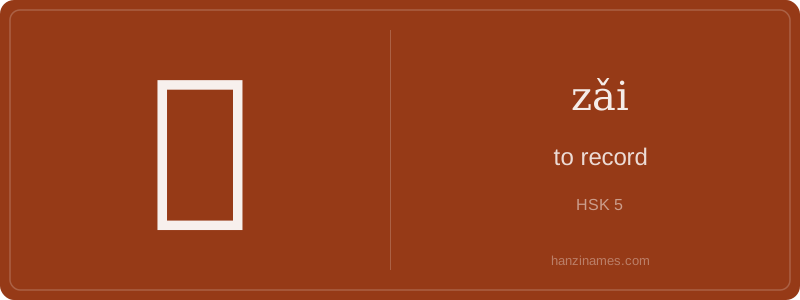
In contemporary China, 载 (zǎi) appears daily in headlines like '本报今日载重要政策解读' ('Today’s newspaper carries an important policy interpretation') — a standard phrase in People’s Daily and Xinhua News Agency reports. It’s integral to formal publishing: 刊载 (kānzǎi), 登载 (dēngzǎi), and 转载 (zhuǎnzǎi) are HSK-5–level terms used across media, legal documents, and academic publishing. The idiom 史不绝载 (shǐ bù jué zǎi, 'history never ceases to record') underscores its enduring link to historical accountability.
The character’s form combines 戈 (gē, 'dagger-axe', radical #62, often associated with action or authority) and 車 (chē, 'cart', now simplified to 车). In bronze inscriptions, 載 depicted a cart bearing cargo — symbolizing 'carrying' literally. Over time, this extended metaphorically to 'carrying meaning into writing'. While the pictographic origin is clear, its semantic shift to 'record' was solidified in Zhou dynasty texts and codified in Han-era dictionaries like 《说文解字》.
The character 载 (zǎi) embodies the ancient Chinese reverence for written record-keeping — a practice central to governance, historiography, and cultural continuity. In classical usage, it appears in titles like 《史记》 (Shǐjì, Records of the Grand Historian), where 载 denotes 'to document' or 'to chronicle' events with authority and permanence. Its presence signals intentionality: not mere mention, but formal inscription into collective memory.
Though pronounced zài in modern contexts like 载重 (zàizhòng, 'load-bearing'), the zǎi reading is reserved for scholarly, literary, and archival functions. This duality reflects how Chinese characters encode semantic nuance through tone and context — one grapheme, two distinct lexical roles. Learners must grasp this split to avoid confusion in academic or journalistic settings.
HSK Level 5 places 载 at the threshold of advanced literacy. Mastery means recognizing its role in compound words like 登载 (dēngzǎi, 'to publish') and 刊载 (kānzǎi, 'to carry [in print]'). It’s frequently encountered in newspapers, academic journals, and official bulletins — always signaling deliberate, authoritative documentation rather than casual reference.
Example Sentences
Common Compounds
Similar Characters — Don't Mix These Up
Your First Step into Chinese Culture: Get a Chinese Name
Every journey into Chinese begins with a name. Use our free Chinese name generator to create a meaningful, personalized Chinese name that fits you perfectly.
Get My Chinese Name →