辑
Character Story & Explanation
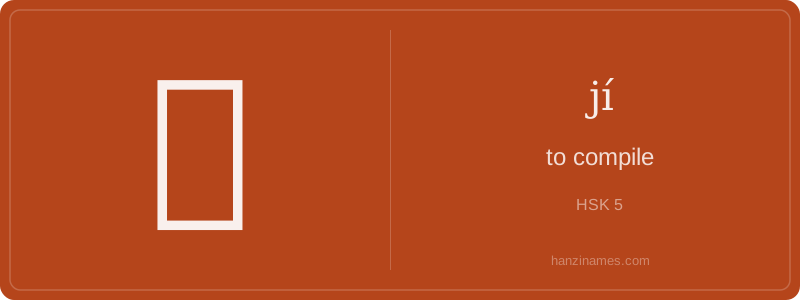
In contemporary Chinese, 辑 is most commonly used in publishing and academia: editors ‘编 辑’ (biān jí) compile articles, journals issue ‘第X辑’ (dì X jí, ‘Volume X’), and scholars ‘辑佚’ (jí yì) recover lost texts. It appears in official titles like 《四库全书总目辑要》 (Siku Quanshu Zongmu Jiyao), a Qing-dynasty bibliographic compendium. Well-known idioms include ‘辑佚钩沉’ (jí yì gōu chén), meaning ‘to recover lost works and unearth forgotten knowledge’—a phrase still used in academic publishing and digital humanities projects.
The character’s form has no oracle-bone or bronze script attestation; it first appears clearly in clerical script (Lìshū) of the Han dynasty. Its left-side 车 radical reflects its historical association with organized transport—metaphorically extended to the ‘movement’ and ‘assembly’ of information. Today, Chinese editors routinely use 辑 in phrases like ‘本期辑录’ (‘this issue’s compiled selections’), emphasizing curated, thematic grouping over casual aggregation.
As an archaeologist brushing dust from a Han dynasty bamboo slip, I uncovered 辑 not as a static glyph—but as a dynamic verb etched in ink and intent. Its left side, 车 (chē, 'chariot'), is no mere decorative radical; in early script, it signaled motion, organization, and coordinated effort—like chariots gathering troops or supplies. The right side, 辑’s phonetic component ‘咠’ (jí), once carried connotations of harmonious speech, suggesting that gathering wasn’t just physical—it was intellectual synthesis.
This character emerged precisely when imperial libraries flourished: Liu Xiang and his son Liu Xin compiled the first state-sponsored bibliographic catalogues around 26 BCE, using 辑 to describe collating scattered texts into coherent anthologies. Their work—‘辑略’ (Jílüè)—was literally ‘gathering summaries’. Here, 辑 encoded authority, curation, and scholarly responsibility: not random collection, but purposeful assembly under discerning judgment.
Modern excavations of Dunhuang manuscripts reveal scribes writing 辑 in colophons like ‘此卷辑自三藏’ (‘This scroll was gathered from the Tripiṭaka’). Unlike generic verbs like 收 (shōu, ‘to receive’) or 拿 (ná, ‘to take’), 辑 implies intentionality, editorial rigor, and systemic integration—echoing its ancient role in binding fragmented knowledge into authoritative wholes. It is the quiet verb behind every anthology, every database, every act of cultural preservation.
Example Sentences
Common Compounds
Similar Characters — Don't Mix These Up
Your First Step into Chinese Culture: Get a Chinese Name
Every journey into Chinese begins with a name. Use our free Chinese name generator to create a meaningful, personalized Chinese name that fits you perfectly.
Get My Chinese Name →