逃
Character Story & Explanation
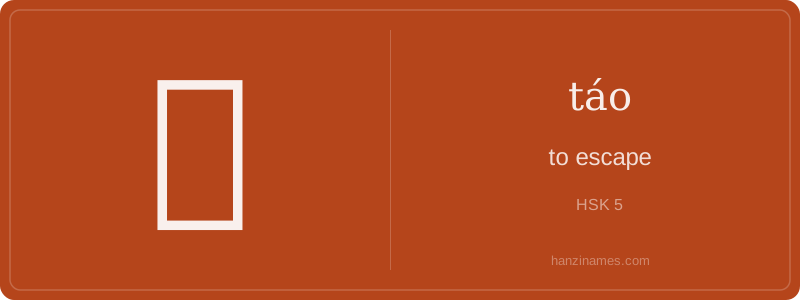
In daily life, 逃 appears frequently in high-stakes contexts: news reports on fugitives (通缉犯逃跑), school anti-bullying campaigns (逃课 means skipping class), and public safety announcements (火灾时请勿乘电梯,请走楼梯逃生). A well-documented idiom is 逃之夭夭 (táo zhī yāo yāo), originally from the *Classic of Poetry*, now used humorously to describe someone vanishing suddenly — though its classical meaning referred poetically to peach blossoms fluttering away.
The character’s written form has no pictographic origin (no oracle-bone sun/moon/tree); instead, it’s a phono-semantic compound. The 辶 radical (‘walking’) conveys motion, while the upper part (originally + 乚) provides sound approximation. Today, Chinese learners practice it using standardized stroke order: start with the dot, then horizontal, then the crucial ‘walking’ radical’s three strokes — a sequence drilled in all HSK 5 textbooks.
As a detective tracing 逃’s evolution, I begin at the oracle-bone and bronze inscriptions — but here’s the twist: 逃 does not appear in those earliest scripts. It first surfaces reliably in Warring States bamboo texts and matured in the small seal script of the Qin dynasty. Its structure is telling: the left component, ⺈ (a variant of , meaning ‘to flee’ or ‘to avoid’), merges with the radical 辶 (chuò), the ‘walking’ or ‘movement’ radical — a clear semantic clue that this character is about *motion away*.
The phonetic element was originally 乚 (yǐn), an archaic form later stylized into the modern top part resembling 亠+厶. Over centuries, clerical and regular script reforms simplified its upper portion while preserving the decisive 辶 radical at the bottom right — a visual anchor signaling directionality and urgency. This isn’t a static pictograph; it’s a functional compound born from administrative and military needs: recording desertions, evasions of duty, or flight from conscription.
Unlike characters like 跑 (to run) — which emphasizes physical speed — 逃 carries moral or legal weight: escaping *consequences*. In classical texts such as the *Zuo Zhuan*, 逃 appears in contexts like ‘fleeing one’s post’ or ‘escaping punishment’, reinforcing its association with avoidance of obligation or danger. Its nine-stroke composition reflects deliberate economy: every stroke serves either phonetic scaffolding or semantic thrust — no flourish, only function. That’s why it remains indispensable in modern Mandarin, from news headlines to courtroom transcripts.
Example Sentences
Common Compounds
Similar Characters — Don't Mix These Up
Your First Step into Chinese Culture: Get a Chinese Name
Every journey into Chinese begins with a name. Use our free Chinese name generator to create a meaningful, personalized Chinese name that fits you perfectly.
Get My Chinese Name →