逗
Character Story & Explanation
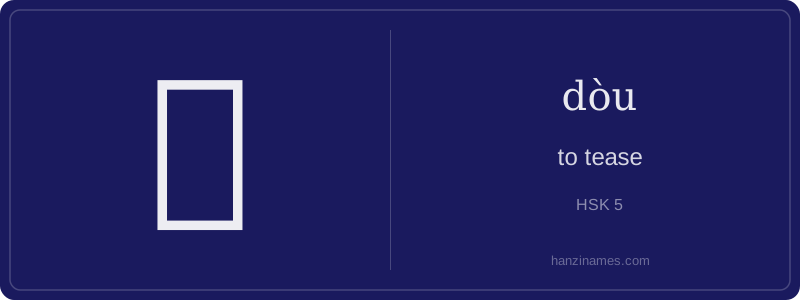
In modern Chinese, 逗 is ubiquitous in spoken and written vernacular—especially in informal registers. It appears in the common phrase 逗你玩儿 (dòu nǐ wánr), meaning 'just kidding!' or 'I’m teasing you!', widely used across generations and documented in sociolinguistic studies of Beijing Mandarin. It also features in the idiom 逗人发笑 (dòu rén fā xiào, 'to make people laugh'), cited in the 《现代汉语词典》 (Contemporary Chinese Dictionary, 7th ed., 2016). Historically, its 'pause/linger' sense survives in classical compound 逗留 (dòu liú, 'to stay temporarily'), still used in legal and travel contexts (e.g., visa regulations).
The character is not pictographic. Its structure is semantic-phonetic: 辶 (the 'walking' radical) signals motion-related meaning, while 豆 provides approximate pronunciation. No oracle bone or bronze script form of 逗 is confirmed; it first appears reliably in clerical script (Lìshū) of the Han dynasty. Today, Chinese speakers commonly use it in lighthearted digital communication—e.g., texting 逗死我了 (dòu sǐ wǒ le, 'You’re killing me with laughter!')—reflecting its enduring role in expressing affectionate provocation.
As an archaeologist sifting through layers of linguistic sediment, I uncover 逗 not as a static glyph but as a dynamic trace of human interaction—its form a fossilized gesture of playful provocation. The radical 辶 (chuò), meaning 'to walk' or 'to move', anchors the character in motion: teasing is never inert—it advances, retreats, circles back. The phonetic component 豆 (dòu, 'bean') may seem arbitrary, but in ancient bronze inscriptions, phonetic loans often prioritized sound over sense, preserving pronunciation across millennia.
This character’s earliest secure attestation appears in Han dynasty bamboo slips (206 BCE–220 CE), where 逗 functions as a verb meaning 'to linger' or 'to pause en route'—a military term for halting troops temporarily. Only later, during the Tang and Song dynasties, does its semantic field expand metaphorically: lingering attention becomes playful delay; pausing to provoke becomes teasing. The shift mirrors how language evolves—not through rupture, but through gentle semantic drift, like silt settling into new riverbeds.
What fascinates me most is how 逗 resists reduction to mere 'joking'. It carries subtle power dynamics: a parent 逗s a child (affectionate control), a poet 逗s ambiguity (artistic invitation), even classical texts describe winds 逗 clouds—suggesting enticement with agency. Unlike 玩 (wán, 'to play'), which implies recreation, 逗 implies intentional, often asymmetrical, engagement. Its ten strokes encode not just sound and meaning, but a centuries-old grammar of relational spark.
Example Sentences
Common Compounds
Similar Characters — Don't Mix These Up
Your First Step into Chinese Culture: Get a Chinese Name
Every journey into Chinese begins with a name. Use our free Chinese name generator to create a meaningful, personalized Chinese name that fits you perfectly.
Get My Chinese Name →