达
Character Story & Explanation
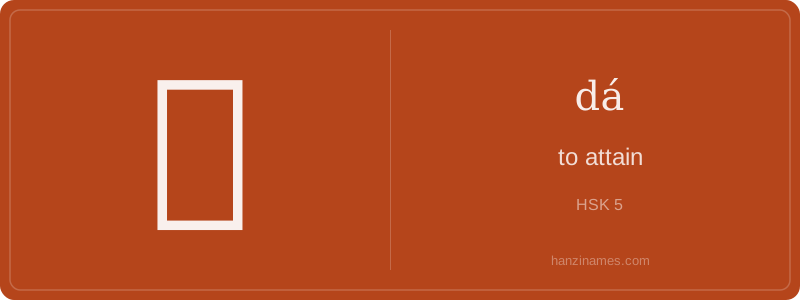
达 is widely used in contemporary Chinese for formal achievement and communication: e.g., '达成共识' (dáchéng gòngshí, 'reach a consensus') appears in government white papers, corporate reports, and news headlines. It’s central in the national education policy term '达标' (dábiāo, 'meet standards'), referring to school performance benchmarks since the 1990s. The idiom '通情达理' (tōngqíng-dálǐ, 'understanding and reasonable')—featuring 达—is among China’s most common compliments for empathetic behavior.
The character evolved from seal script, where 达 combined 大 ('great') and 辶 ('to walk/move'), symbolizing 'progressing to greatness' or 'reaching a high level'. This semantic composition is well-documented in authoritative sources like the *Shuōwén Jiězì* (c. 100 CE), confirming its original sense of 'thorough attainment'—not just arrival, but full realization.
Hi students! Let’s learn 达 (dá), a useful and elegant character meaning 'to attain', 'to reach', or 'to achieve'. It’s not about physical arrival only—it often expresses accomplishment of goals, understanding, or communication. Though it looks simple (just 6 strokes!), its meaning is rich and abstract. You’ll see it in formal speech, writing, and academic contexts more than in casual chats. Remember: 达 is never used alone in modern Chinese—it always appears in compounds like 到达 (dàodá, 'to arrive') or 达成 (dáchéng, 'to reach an agreement').
This character belongs to the ‘walking’ radical 辶 (chuò), which hints at movement or progression—fitting for a word about reaching or achieving something. Unlike many HSK-5 characters that are highly specialized, 达 appears across everyday domains: education (达标, 'meet standards'), business (达成合作, 'reach cooperation'), and even tech (数据达标, 'data meets requirements'). Its tone is neutral but slightly formal—think of it as the polite, precise cousin of simpler verbs like 到 (dào, 'to arrive').
As a teacher, I recommend practicing 达 with goal-oriented vocabulary: targets, agreements, standards, and understanding. Notice how it pairs with nouns (e.g., 目标 dábiodāo, 'target') or verbs (e.g., 成, 意) to form meaningful two-character words. Don’t confuse it with similar-sounding characters like 大 (dà, 'big')—they’re unrelated in meaning or origin. Writing it correctly matters: the radical 辶 wraps around the top-right component 大, so stroke order ensures balance and legibility.
Example Sentences
Common Compounds
Similar Characters — Don't Mix These Up
Your First Step into Chinese Culture: Get a Chinese Name
Every journey into Chinese begins with a name. Use our free Chinese name generator to create a meaningful, personalized Chinese name that fits you perfectly.
Get My Chinese Name →