遗
Character Story & Explanation
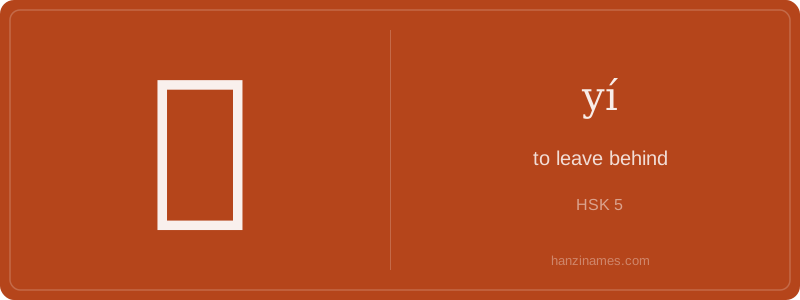
遗 is widely used in modern Chinese legal, medical, and cultural contexts: 遗嘱 (yízhǔ, 'last will') is a formal, notarized document; 遗传 (yíchuán, 'heredity') appears in biology textbooks and health reports; and 遗迹 (yíjì, 'ruins/traces') labels UNESCO sites like the Terracotta Army. The idiom 遗臭万年 (yíchǒu wànnián, 'to leave a stench for ten thousand years') — famously applied to corrupt officials — shows its enduring moral register.
The character evolved from seal script, where the left side (辶 + 貴) originally suggested 'precious thing left while departing'. Though its oracle-bone origins are unattested, the modern form clearly combines 辶 (chuò, 'walking radical', indicating motion/leaving) and 貴 (guì, 'precious') — visually encoding 'what is precious that one leaves behind'. Today, Chinese students learn its stroke order as standardized by the PRC’s 2013 *List of Commonly Used Characters*.
The Chinese character 遗 (yí) carries the core meaning 'to leave behind' — not merely physically abandoning something, but often implying intentional or consequential legacy: unfulfilled duties, inherited traits, forgotten knowledge, or posthumous bequests. Unlike English verbs like 'abandon' (which connotes neglect) or 'bequeath' (which implies legal intent), 避 bridges both passive and active senses — a person may 遗忘 (yíwàng, 'forget') involuntarily, yet also 遗留 (yíliú, 'leave behind') cultural artifacts deliberately.
In classical Chinese, 遗 frequently appears in moral and historical texts to denote what ancestors transmit — whether virtue, warning, or ruin. The *Zuo Zhuan* and Han dynasty edicts use it to describe how rulers’ actions ‘leave behind’ consequences for future generations. This imbues 遗 with ethical weight: leaving behind is never neutral — it shapes lineage, reputation, and collective memory.
Western equivalents vary by context: 'bequeath' fits legal inheritance; 'bequeath' and 'endow' capture intentional transmission; 'legacy' or 'heritage' mirror noun forms like 遗产 (yíchǎn). Yet no single English word replicates 遗’s duality — its capacity to mean both 'to lose unintentionally' (as in 遗漏 yílòu, 'omit') and 'to entrust intentionally' (as in 遗嘱 yízhǔ, 'will'). This semantic range reflects Confucian emphasis on intergenerational responsibility — what one leaves behind defines one’s moral footprint.
Example Sentences
Common Compounds
Similar Characters — Don't Mix These Up
Your First Step into Chinese Culture: Get a Chinese Name
Every journey into Chinese begins with a name. Use our free Chinese name generator to create a meaningful, personalized Chinese name that fits you perfectly.
Get My Chinese Name →