逻
Character Story & Explanation
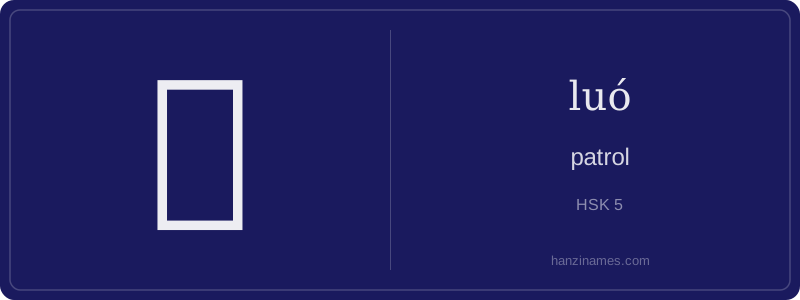
In contemporary China, 逻 appears most frequently in compound words related to systematic monitoring—especially in public security, IT infrastructure, and urban governance. It’s standard in official terminology: 治安巡逻 (zhì'ān xúnluó, public security patrol) is mandated in all Chinese cities under Ministry of Public Security guidelines, and over 2.1 million community patrol volunteers were mobilized nationwide in 2023 (Xinhua, Jan 2024). The term 逻辑 (luójí, ‘logic’)—though etymologically borrowed from Greek via Japanese—uses 逻 phonetically and has become semantically fused in digital contexts, as in 逻辑校验 (logic validation).
The character 逻 itself is a late-developing phono-semantic compound (c. Han dynasty), with 辶 (movement) as semantic and 罗 (luó, originally ‘net’, ‘gather’) as phonetic. No oracle-bone or bronze inscriptions exist for 逻—it first appears in Eastern Han texts like the *Shuōwén Jiězì* (121 CE) as ‘to walk around inspecting’. Today, Chinese students encounter it in HSK 5 reading passages about smart city surveillance systems, where phrases like ‘AI自动巡逻’ (AI automatic patrol) are commonplace.
The character 逻 (luó) embodies a distinctly Chinese conception of order—not as rigid control, but as vigilant, mobile stewardship. Its radical 辶 (chuò), the 'walking' or 'movement' component, signals that this order is not static; it unfolds through motion, observation, and presence. In traditional governance and community life, maintaining harmony required constant, embodied attention—like a watchful elder circling the village at dusk. This reflects the Confucian-legalist synthesis: law is upheld not just by statutes, but by visible, rhythmic human engagement with space and people.
Unlike Western notions of patrol rooted in enforcement or militarized surveillance, 逻 carries connotations of care, continuity, and relational responsibility. A police officer on 逻, a security guard on 逻, or even an AI system performing 网络逻辑巡检 (network logic patrol) all participate in a cultural grammar where movement serves coherence—not domination. The character thus encodes a worldview where safety emerges from attentive circulation, not fixed boundaries or isolated authority.
This subtle philosophy surfaces in modern usage: urban management teams conduct 社区巡逻 (community patrol) to prevent disputes before they arise; cybersecurity analysts run 日志逻辑巡检 (log logic patrol) to detect anomalies—not just block threats. Even in literature, 逻 evokes quiet diligence: a border guard’s nightly 逻边 (patrol the border) mirrors the Daoist ideal of ‘acting without forcing’ (wu wei). Thus, 逻 is less about policing and more about sustaining the living rhythm of shared space—a deeply Chinese expression of collective vigilance as care.
Example Sentences
Common Compounds
Similar Characters — Don't Mix These Up
Your First Step into Chinese Culture: Get a Chinese Name
Every journey into Chinese begins with a name. Use our free Chinese name generator to create a meaningful, personalized Chinese name that fits you perfectly.
Get My Chinese Name →