酱
Character Story & Explanation
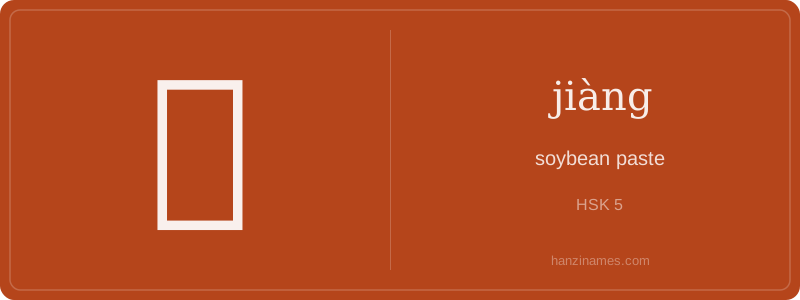
酱 has been central to Chinese cuisine since at least the Zhou dynasty (1046–256 BCE), documented in texts like the Rites of Zhou listing over 100 types—including meat, fish, and soy-based variants. Today, it’s indispensable: doubanjiang (broad-bean paste) defines Sichuan cooking; sweet bean sauce (tiánmiànjiàng) coats Peking duck. The phrase ‘画龙点睛’ (huà lóng diǎn jīng) doesn’t contain 酱—but ‘酱’ entered modern slang via internet homophone play: ‘酱’ sounds like ‘这样’ (zhèyàng, 'like this'), yielding playful abbreviations like ‘酱紫’ (jiàng zǐ) for ‘这样子’—though this is colloquial, not classical usage.
The character’s written form is not pictographic but a standardized semantic-phonetic compound. The left radical 酉 appears in all fermentation-related characters (e.g., 酒 jiǔ 'wine', 醋 cù 'vinegar'). The right component 将 (jiāng) was selected for its phonetic match to jiàng—not its meaning—reflecting standard Han-era script reform practices.
Unearthing 酱 (jiàng) feels like brushing dust from a Han dynasty pottery jar sealed with fermented soybean paste—its radical 酉 (yǒu), meaning 'wine vessel', reveals its ancient kinship with fermentation, not just food but alchemy. This character first appears in bronze inscriptions and early dictionaries like the Shuōwén Jiězì (121 CE), where it’s defined as 'a condiment made by fermenting beans with salt and grain'. Its thirteen strokes encode a ritual: the left side presides over fermentation; the right, the process—mashing, aging, transforming.
The character’s structure is a functional fossil: 酉 on the left signals preservation through fermentation (shared with wine, vinegar, and medicine); the right component 将 (jiāng, 'to lead' or 'to command') hints at human agency—guiding microbes, timing salt additions, mastering decay into flavor. Unlike pictographs of sun or water, 酱 is a semantic-phonetic compound (形声字), where sound and meaning co-evolved: 将 provides pronunciation *jiàng*, while 酉 anchors its domain—fermented, liquid-preserved substances.
Archaeobotanical evidence from Mawangdui tombs (2nd c. BCE) confirms soybean pastes were buried with elites—suggesting 酱 was both culinary staple and spiritual offering. Its enduring form across 2,000 years reflects stability in technique: same vessels, same microbial cultures, same cultural weight. To write 酱 today is to trace the hand of a Han dynasty fermenter—measuring brine, stirring mash, sealing jars under watchful stars. This isn’t mere seasoning—it’s time crystallized in umami.
Example Sentences
Common Compounds
Similar Characters — Don't Mix These Up
Your First Step into Chinese Culture: Get a Chinese Name
Every journey into Chinese begins with a name. Use our free Chinese name generator to create a meaningful, personalized Chinese name that fits you perfectly.
Get My Chinese Name →