销
Character Story & Explanation
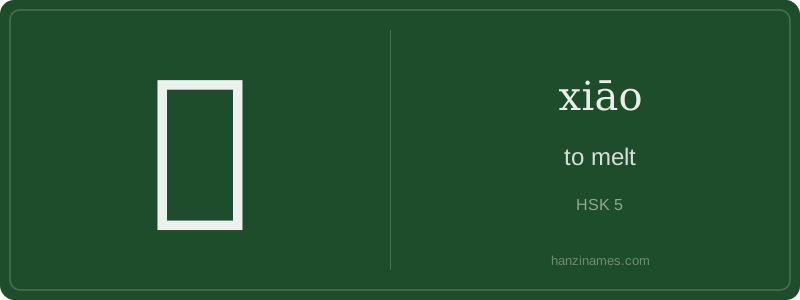
销 is widely used in modern Mandarin across legal, commercial, and technical domains: 销售 (xiāoshòu, 'sales') appears in over 90% of Chinese corporate job titles involving marketing; 销毁 (xiāohuǐ, 'to destroy/annihilate') is standard in official documents for evidence disposal or banned goods. The HSK 5 curriculum emphasizes 销 as a high-frequency verb in economic and administrative contexts. It also appears in the idiom 销声匿迹 (xiāoshēng nìjì, 'to vanish without a trace'), dating back to Tang-dynasty literary criticism.
The character is a phono-semantic compound: left radical 钅 (jīn, 'metal') signals semantic field; right component 肖 (xiāo) provides pronunciation and originally meant 'to resemble'—suggesting melted metal takes on new, recognizable forms. No oracle-bone or bronze-inscription form survives, but its earliest attested use is in Han dynasty texts referring to melting down coins for reuse—a documented fiscal practice during currency reforms.
The character 销 (xiāo) embodies a profound duality in the Chinese worldview: transformation through dissolution. While its basic meaning is 'to melt'—evoking physical change like metal liquefying in fire—it extends metaphorically to 'elimination', 'cancellation', or 'sales' (as in 'melting away inventory'). This reflects a classical Daoist and practical sensibility: nothing vanishes entirely; it merely changes form or function. Melting is not destruction but redistribution—aligning with the cyclical, process-oriented understanding of reality central to Chinese philosophy.
Historically, 销 emerged in bronze-age metallurgy contexts, where controlled melting was essential for casting ritual vessels and weapons. Its radical 钅 (metal) anchors it in material culture, while the phonetic component 肖 (xiāo) hints at resemblance and replication—suggesting that melting enables rebirth into new shapes. Thus, 销 carries quiet optimism: endings are preludes to renewal, and even loss serves purpose within larger systems of balance and flow.
In modern usage, 销 bridges ancient craft and digital commerce—equally at home in phrases like 销毁 (destroy) and 销售 (sell). This semantic elasticity mirrors China’s cultural adaptability: honoring tradition while fluidly reassigning meaning to meet new realities. To ‘melt’ is not passive surrender but strategic release—releasing old forms to make space for innovation, echoing Confucian pragmatism and Buddhist impermanence alike. 销 thus becomes a quiet lens into how Chinese thought values functional transformation over static permanence.
Example Sentences
Common Compounds
Similar Characters — Don't Mix These Up
Your First Step into Chinese Culture: Get a Chinese Name
Every journey into Chinese begins with a name. Use our free Chinese name generator to create a meaningful, personalized Chinese name that fits you perfectly.
Get My Chinese Name →