闭
Character Story & Explanation
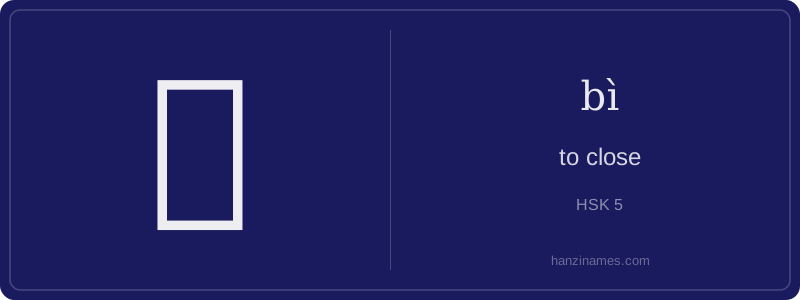
In daily life, 闭 is ubiquitous in public signage across China: subway station notices read ‘本入口已关闭’ (běn rùkǒu yǐ guānbì, 'This entrance is closed'); government announcements use 闭园 (bì yuán, 'park closed') during extreme weather; and tech platforms display ‘服务已关闭’ (fúwù yǐ guānbì, 'service suspended'). Historically, 闭 appears in classical texts like the Book of Rites (Lǐjì), where 闭塞 (bìsè) denotes obstruction of qi or communication — a concept still invoked in traditional medicine and political discourse.
The character’s form is not pictographic but phono-semantic: 门 (mén) is the semantic radical (indicating gate-related meaning), while 十 was historically a phonetic component approximating ancient pronunciation. Modern standardization fixed this structure during the Qin dynasty’s script unification — no oracle bone or bronze inscription evidence shows an earlier pictorial 'door with bolt' form.
The character 闭 (bì) visually embodies the idea of closure: its outer frame 门 (mén, 'gate') encloses the inner component 十 (shí, originally a simplified form of 扌 or later standardized as a phonetic/semantic marker), suggesting something sealed within a doorway. This structural logic mirrors how Chinese characters often combine meaning and sound — here, 门 signals the domain (entryways, access), while the interior element hints at completion or restriction.
At HSK Level 5, 闭 marks a shift from basic verbs to nuanced, abstract uses — not just physical closing, but shutting down operations, ending discussions, or withdrawing emotionally. Learners encounter it in formal contexts: news reports about closed borders, policy documents citing suspended services, or literature describing introspective solitude.
Its six-stroke simplicity belies semantic richness: 闭 appears in compound verbs like 关闭 (guānbì, 'to shut down'), idioms like 闭门造车 (bì mén zào chē, 'to make a cart behind closed doors' — i.e., working in isolation), and technical terms like 闭合电路 (bìhé diànlù, 'closed circuit'). Mastery requires recognizing how context transforms 'close' into 'suspend', 'seal', 'withdraw', or even 'suppress'.
Example Sentences
Common Compounds
Similar Characters — Don't Mix These Up
Your First Step into Chinese Culture: Get a Chinese Name
Every journey into Chinese begins with a name. Use our free Chinese name generator to create a meaningful, personalized Chinese name that fits you perfectly.
Get My Chinese Name →