陌
Character Story & Explanation
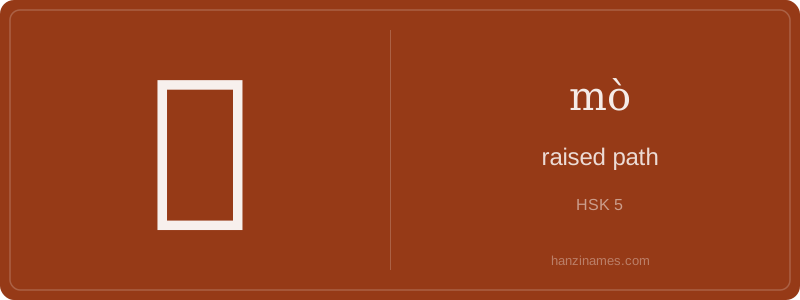
In modern Chinese, 陌 appears almost exclusively in fixed compounds: 陌生 (mòshēng, ‘unfamiliar’), 陌路 (mòlù, ‘estranged people’), and the classical term 阡陌 (qiānmò, ‘field paths’). It’s absent from everyday vocabulary like ‘road’ (路 lù) or ‘street’ (街 jiē). The idiom 萍水相逢,终成陌路 (píngshuǐ xiāngféng, zhōng chéng mòlù)—‘meeting by chance, ending as strangers’—is taught in HSK 5 textbooks and appears in official language exams. Historically, 陌 was documented in the *Rites of Zhou* (c. 3rd century BCE) as part of standardized land surveying terminology.
The character’s form is not pictographic but phono-semantic: the right component 百 (bǎi) signals approximate pronunciation (mò and bǎi share Middle Chinese entering-tone endings), while the left 阝 (originally 阜, fù, ‘mound/hill’) indicates terrain-related meaning. No oracle bone or bronze script forms survive for 陌—its earliest attestation is in Warring States bamboo slips (4th c. BCE), consistently written with this structure.
The character 陌 (mò) originally depicted a raised, earthen path—distinct from ordinary roads—used in ancient Chinese agricultural landscapes to separate fields or facilitate drainage. Its left side, 阝 (the 'hill' or 'village' radical, here representing terrain), combines with 百 (bǎi, 'hundred') on the right, not as a number but as a phonetic component. Though 百 suggests pronunciation, the meaning is tied to topography: elevated, man-made pathways between rice paddies or millet fields in the North China Plain.
In classical texts like the *Book of Han*, 陌 appears alongside 阡 (qiān)—together forming 阡陌—referring to the orthogonal grid of field boundaries: 仟 ran north-south (‘qian’ paths), 陌 ran east-west (‘mo’ paths). This system reflected both practical land management and Confucian ideals of order. Over time, 陌 shifted semantically: because these paths led *between* villages—neither fully ‘here’ nor ‘there’—it acquired connotations of ‘strange’, ‘unfamiliar’, and eventually ‘stranger’.
Today, 陌 survives most vividly in literary and idiomatic usage rather than daily speech. It’s rarely used alone; instead, it thrives in compounds like 陌生 (mòshēng, ‘unfamiliar’) and 陌路 (mòlù, ‘strangers who’ve lost connection’). Its HSK 5 status reflects its role in advanced comprehension—not as a functional word, but as a cultural linchpin linking geography, history, and emotion. Learners encounter it not in markets or metro signs, but in essays, poetry, and nuanced expressions of alienation or nostalgia.
Example Sentences
Common Compounds
Similar Characters — Don't Mix These Up
Your First Step into Chinese Culture: Get a Chinese Name
Every journey into Chinese begins with a name. Use our free Chinese name generator to create a meaningful, personalized Chinese name that fits you perfectly.
Get My Chinese Name →