阵
Character Story & Explanation
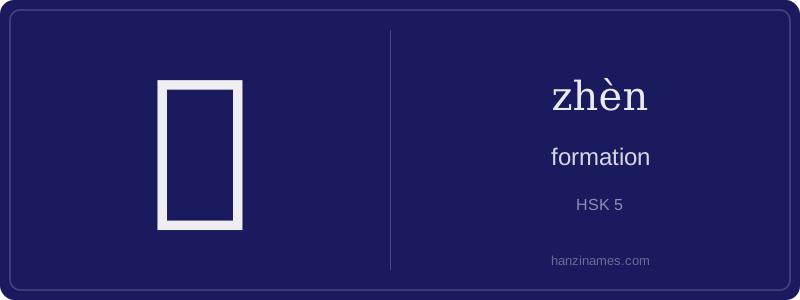
Historically, 阵 appears frequently in military texts like Sun Tzu’s Art of War and Tang dynasty battle records, where it denotes tactical formations—e.g., the famous ‘crane array’ (鹤阵) or ‘fish-scale array’ (鱼鳞阵). In modern usage, it’s ubiquitous in compound words like 阵风 (zhènfēng, ‘gust of wind’) and 阵痛 (zhèntòng, ‘labor pain’), reflecting its semantic shift from military disposition to any bounded, intense, transient phenomenon. The idiom 临阵脱逃 (lín zhèn tuōtáo, ‘to flee on the eve of battle’) remains widely taught in schools and used in political discourse to criticize last-minute cowardice.
The character’s form combines 阝 (the ‘mound’ or ‘city wall’ radical, indicating place/defense) with 车 (chē, ‘chariot’—originally written as 車, now simplified). This reflects its Bronze Age origin: chariots were central to Zhou dynasty battlefield formations. Archaeological inscriptions from the Warring States period confirm 阵’s use in describing chariot-based troop deployments—making its etymology historically verifiable and materially grounded.
The character 阵 (zhèn) embodies a foundational Chinese worldview where order, strategy, and timing converge in human affairs. Originally military—denoting the deliberate arrangement of troops on the battlefield—it reflects the classical Confucian and Daoist belief that harmony arises not from chaos but from intentional structure: a 'formation' that aligns people, space, and moment. This idea extends beyond war into governance, medicine, and even weather patterns—where natural phenomena are also described as ‘arrays’ (e.g., a阵 of wind), revealing how deeply the Chinese language maps social logic onto cosmic rhythm.
What makes 阵 culturally distinctive is its dual temporal-spatial nature: it signifies both a physical configuration (troops in formation) and a bounded duration (a sudden burst—a阵of rain). This duality mirrors the Chinese perception of time not as linear, but as episodic—events arrive in ‘arrays’, each with its own shape, intensity, and boundary. Thus, 阵 subtly teaches that change is neither random nor continuous, but organized, recurrent, and contextually framed—like seasonal winds or tactical maneuvers.
In everyday Chinese thought, 阵 carries quiet philosophical weight: to witness a阵is to recognize a meaningful unit within flux. Whether it’s a阵of laughter in a crowded room or a阵of anxiety before an exam, the character invites awareness of transient yet structured human experiences. It resists reduction to mere ‘moment’ or ‘burst’—instead, it honors the coherence within transience, echoing the broader cultural reverence for patterned change (e.g., yin-yang cycles, agricultural seasons). In this way, 阵 is less a word than a lens—one that reveals order in motion, discipline in spontaneity, and intention in impermanence.
Example Sentences
Common Compounds
Similar Characters — Don't Mix These Up
Your First Step into Chinese Culture: Get a Chinese Name
Every journey into Chinese begins with a name. Use our free Chinese name generator to create a meaningful, personalized Chinese name that fits you perfectly.
Get My Chinese Name →