雄
Character Story & Explanation
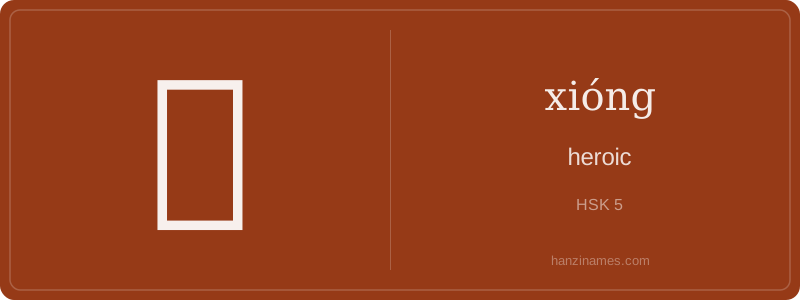
雄 is widely used in formal and literary contexts to denote excellence, dominance, or masculine virtue—not merely biological sex. Common phrases include 雄厚 (xióng hòu, 'substantial/robust', e.g., 雄厚的资金—substantial capital) and 雄辩 (xióng biàn, 'eloquent, forceful argument'). Historically, it appears in the *Zuo Zhuan* (c. 4th century BCE) describing '雄才大略' (heroic talent and grand strategy) of statesmen. The idiom 雄视天下 ('to dominate the world') reflects its enduring association with authoritative presence.
The character combines 隹 (zhuī, 'short-tailed bird' radical) and 攵 (pū, 'to strike' or 'action' component, evolved from 又 + 攴). Archaeological evidence (Shuowen Jiezi, 100 CE) confirms its original pictographic link to a large, imposing bird—likely the eagle or pheasant—symbolizing dominance in nature. This avian origin directly informs its semantic extension to human excellence and authority.
Imagine walking through Beijing’s Temple of Heaven on a crisp autumn morning. A tour guide points to the imperial altar and says, 'This was where emperors performed rituals to honor heaven—symbolizing the ultimate 雄 authority: strong, dignified, and commanding.' The character 雄 isn’t just about biological maleness; it embodies noble strength, leadership, and moral vigor—a quality historically reserved for virtuous rulers and heroic figures.
In modern China, 雄 appears in contexts far beyond gender. You’ll see it on banners at the Shanghai Auto Show—'雄心勃勃的新能源战略' (an ambitious new-energy strategy)—or in sports headlines celebrating the national men’s volleyball team’s ‘雄风’ (heroic spirit). It conveys aspiration, dominance in a positive sense, and unshakable confidence—not aggression, but principled power.
Even children encounter 雄 early: in the idiom 雄心壮志 (xióng xīn zhuàng zhì), meaning 'lofty ambition', taught in Grade 5 textbooks (People’s Education Press, HSK 5-aligned curriculum). Teachers emphasize that 雄 here doesn’t mean 'male person', but 'grand, vigorous, and resolute'—a semantic shift rooted in classical Chinese, where it described majestic birds like eagles before extending metaphorically to human virtue.
Example Sentences
Common Compounds
Similar Characters — Don't Mix These Up
Your First Step into Chinese Culture: Get a Chinese Name
Every journey into Chinese begins with a name. Use our free Chinese name generator to create a meaningful, personalized Chinese name that fits you perfectly.
Get My Chinese Name →