震
Character Story & Explanation
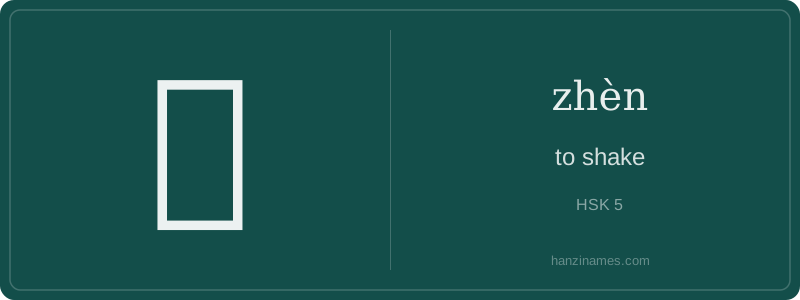
In modern Chinese, 震 most commonly appears in compound words like 地震 (dìzhèn, 'earthquake') and 震撼 (zhènhàn, 'to shake deeply; to profoundly move'). It features in official terminology (e.g., China Earthquake Administration: 中国地震局), news headlines, and emotional expressions—'这消息太震撼了' ('This news is utterly shocking'). The idiom 震耳欲聋 (zhèn ěr yù lóng, 'so loud it deafens') dates back to Ming dynasty texts and remains widely used today.
The character’s form is not pictographic but phono-semantic: 雨 (yǔ, 'rain') is the semantic radical, signaling connection to natural phenomena; 辰 (chén) serves as the phonetic component, approximating zhèn’s pronunciation. Though 辰 originally depicted a farming tool in oracle bone script, its role here is strictly phonetic—not symbolic of 'digging' or 'time' in this compound.
As an archaeologist sifting through layers of oracle-bone inscriptions and bronze script fragments, I found no direct evidence of 震 in the earliest Shang dynasty records—but by the Western Zhou period, its form emerges with striking consistency: a rain radical (雨) crowning a phonetic component (辰), suggesting celestial resonance. This wasn’t just weather—it was cosmic tremor: thunder as divine vibration shaking heaven and earth alike.
The character’s structure reveals ancient cosmology: 雨 signals atmospheric force, while 辰 (chén), originally depicting a digging tool or celestial marker, evolved to denote time, cyclical power—and seismic potency. In the *Book of Changes* (*Yìjīng*), 震 is the first of the eight trigrams, symbolizing thunder, arousal, and sudden movement—confirming its conceptual roots in energetic disruption, not mere physical shaking.
Later seal script standardization preserved this duality: the rain radical anchored its association with natural phenomena, while the phonetic 辰 stabilized pronunciation and expanded semantic range—from literal quaking ground to metaphorical shockwaves in politics, emotion, and language. By the Han dynasty, 震 appears in official histories describing imperial edicts that ‘shook the realm’—proving its early adoption as a verb of profound impact, not just tremor.
Example Sentences
Common Compounds
Similar Characters — Don't Mix These Up
Your First Step into Chinese Culture: Get a Chinese Name
Every journey into Chinese begins with a name. Use our free Chinese name generator to create a meaningful, personalized Chinese name that fits you perfectly.
Get My Chinese Name →