项
Character Story & Explanation
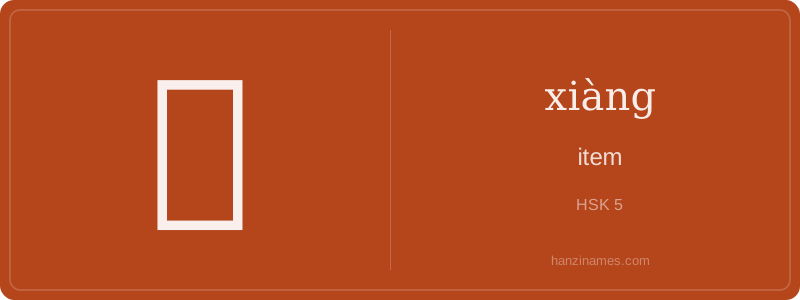
In modern usage, 项 appears ubiquitously in formal and bureaucratic contexts: government policy documents, engineering specifications, financial reports, and academic syllabi all organize content into 项目 (xiàngmù, 'projects' or 'items'). The idiom 万项 (wàn xiàng, 'ten thousand items') appears in classical texts like the *Huainanzi* to denote exhaustive scope—not literally counting necks, but invoking comprehensiveness rooted in bodily metaphor.
Graphically, 项 is a phono-semantic compound: radical 页 (yè, 'page' or 'head') indicates its original connection to the head/neck region, while 工 (gōng, 'work') serves as a phonetic component (though pronunciation diverged over time). Its earliest attested form appears in seal script (c. 3rd c. BCE), clearly showing the head radical with a simplified phonetic element—no oracle bone evidence survives, but its structure was standardized by the Qin dynasty’s script unification.
The character 项 (xiàng) begins as a concrete anatomical reference—the back of the neck—but quickly expands into abstract domains of structure and enumeration. In classical Chinese thought, the body is a microcosm of order: the neck connects head (mind, authority) to torso (body, action), making 项 a natural metaphor for pivotal points—be they items in a list, clauses in a contract, or key provisions in law. This reflects a worldview where physical reality grounds linguistic abstraction.
This semantic evolution mirrors Confucian and Legalist administrative traditions, where precision in naming and categorizing mattered deeply. A ‘list item’ (项目) isn’t neutral—it implies accountability, hierarchy, and traceability. Even today, government work plans and corporate KPIs are broken into 项, reinforcing that meaning arises not from isolated units but from their placement within an ordered whole.
Unlike Western notions of ‘items’ as interchangeable atoms, 项 carries quiet weight: each 项 bears responsibility, context, and relational position. When someone says ‘this 项 requires approval’, it evokes not just a checkbox but a node in a network of duty and consequence. Thus, 项 reveals how Chinese language embeds ethics in grammar—every counted thing is also a commitment.
Example Sentences
Common Compounds
Similar Characters — Don't Mix These Up
Your First Step into Chinese Culture: Get a Chinese Name
Every journey into Chinese begins with a name. Use our free Chinese name generator to create a meaningful, personalized Chinese name that fits you perfectly.
Get My Chinese Name →