类
Character Story & Explanation
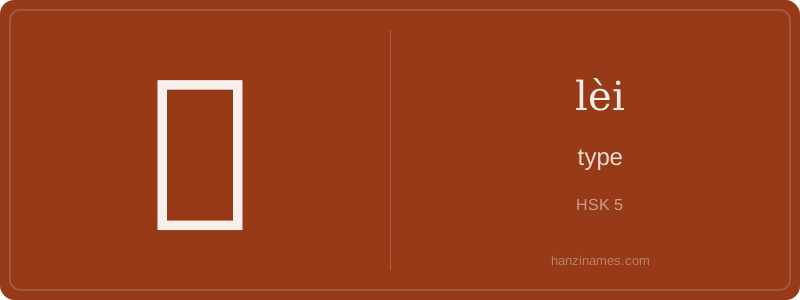
类 is ubiquitous in contemporary Chinese life — from HSK exam instructions ('请选出同类项', qǐng xuǎn chū tóng lèi xiàng — 'select the item of the same category') to WeChat group names ('留学类群', liúxué lèi qún — 'study-abroad-related group'). It appears in the official term for 'category-based poverty alleviation' (分类扶贫, fēn lèi fúpín), a cornerstone policy since 2013. The idiom '物以类聚' (wù yǐ lèi jù — 'like attracts like') dates to the Han dynasty Yi Zhuan commentary and remains widely quoted in media and education.
Classically, 类 evolved from the oracle-bone script form 爪+頁+犬 (claw + head + dog), later simplified under Qin standardization. By the Han dynasty, it stabilized as 大 (dà, 'big') + 頁 (yè, 'head/page'), reflecting its semantic shift toward abstract classification — 'greatness' of conceptual scope, not physical size. Today, learners write it with 9 strokes following standardized GB2312 order.
The Chinese character 类 (lèi) fundamentally expresses conceptual grouping — not just physical similarity, but shared essential qualities that justify classification. Unlike English 'kind' or 'type', which often imply loose resemblance, 类 carries a stronger logical or taxonomic weight, echoing Confucian and Daoist traditions where categorization reflects cosmic order and ethical reasoning. It appears in philosophical texts like the Mencius to distinguish human nature from animal instinct, underscoring moral categories.
In modern usage, 类 functions as both noun and suffix, enabling precise abstraction: 'vegetable类' (shūcài lèi) means 'the vegetable category', not just 'a kind of vegetable'. This mirrors Western scientific taxonomy (e.g., Linnaean 'class'), yet remains deeply embedded in everyday speech — from AI training data ('training类') to food labeling ('non-GMO类'). Its grammatical flexibility exceeds English equivalents.
Culturally, 类 reflects China’s long-standing emphasis on relational logic over binary opposition. While Western thought often prioritizes 'either/or', 类 supports 'both/and' reasoning — e.g., a person can belong to multiple 类 simultaneously (student类, parent类, migrant类). This resonates with networked identity models gaining traction globally, making 类 more than vocabulary: it’s a cognitive lens shaped by millennia of administrative, philosophical, and pedagogical practice.
Example Sentences
Common Compounds
Similar Characters — Don't Mix These Up
Your First Step into Chinese Culture: Get a Chinese Name
Every journey into Chinese begins with a name. Use our free Chinese name generator to create a meaningful, personalized Chinese name that fits you perfectly.
Get My Chinese Name →