骤
Character Story & Explanation
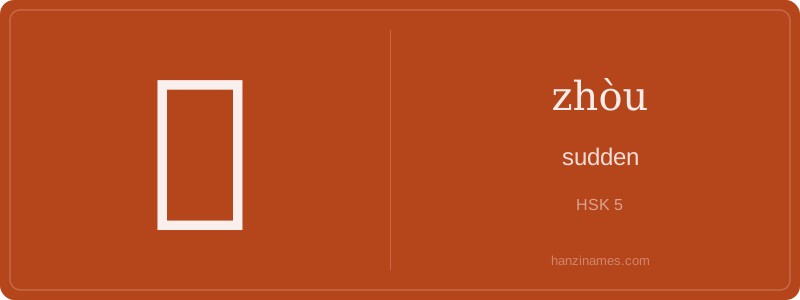
骤 appears frequently in modern Chinese media to describe abrupt socio-economic shifts—e.g., '房价骤涨' (housing prices surged suddenly), cited in People’s Daily (2021) reporting on post-pandemic market volatility. It anchors classical idioms like 风云突变 (fēngyún tūbiàn, 'wind and clouds change abruptly'), where 骤 intensifies the sense of destabilizing transformation. Historically, it appears in Song dynasty medical texts describing sudden-onset fevers (《太平惠民和剂局方》).
The character evolved from seal script: left side 马 clearly depicts a horse’s head and mane; right side 取 originally showed hand (又) grasping ear (耳), symbolizing decisive action (ancient ritual of taking captives’ ears). By Han times, 取 became standardized as a phonetic component, though its visual legacy still echoes 'seizing the moment'—perfectly fitting 骤’s semantics of abrupt agency.
Unearthing 骤 feels like brushing dust from a bronze chariot axle—its radical 马 (horse) immediately signals motion, urgency, and ancient transport. The right side 取 (qǔ, 'to take') is not merely phonetic; in early clerical script, it evokes the act of seizing control mid-gallop—a horse reined in abruptly, embodying suddenness as physical force arrested in time. This isn’t abstract speed—it’s visceral, embodied rupture.
The character’s 17-stroke structure mirrors its semantic weight: every stroke reinforces tension—horizontal lines compress like coiled springs; the final捺 (nà, sweeping stroke) mimics a horse’s hind leg kicking up dust mid-lurch. In Tang dynasty poetry, 骤 appears in weather descriptions—not ‘fast rain’, but rain that *shatters* calm, arriving without warning like an imperial edict sealed and delivered at midnight.
Unlike generic synonyms for ‘sudden’, 骤 carries a trace of violence or inevitability—like tectonic shift disguised as weather. Its HSK 5 placement reflects not just rarity, but conceptual density: learners must grasp not only lexical meaning but also its role in marking *causal rupture*—a before-and-after hinge in narrative, history, and natural phenomena.
Example Sentences
Common Compounds
Similar Characters — Don't Mix These Up
Your First Step into Chinese Culture: Get a Chinese Name
Every journey into Chinese begins with a name. Use our free Chinese name generator to create a meaningful, personalized Chinese name that fits you perfectly.
Get My Chinese Name →