齿
Character Story & Explanation
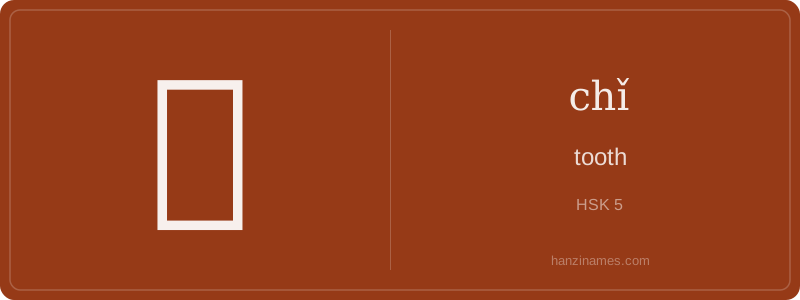
In modern Chinese, 齿 appears most frequently in formal, medical, or literary contexts—especially in compounds like 牙齿 (yá chǐ, 'teeth') and 年齿 (niánchǐ, 'age'). The idiom 唇亡齿寒 (chún wáng chǐ hán, 'When lips are gone, teeth feel the cold')—a well-documented Warring States-era metaphor for interdependence—is taught in middle school textbooks and cited in official media. Dentists’ licenses and national oral health reports consistently use 齿 in standardized terminology.
The character is a stylized pictograph: oracle bone and bronze inscriptions show upper and lower rows of teeth inside a mouth outline. By the seal script era (c. 3rd century BCE), it had stabilized into its current structure—eight strokes representing the jawbone frame and paired teeth. This documented evolution is confirmed by paleographic studies in works like *The Origin and Development of Chinese Characters* (Wang Ning, 2017).
Imagine stepping into a bustling Beijing dental clinic on a rainy Tuesday—white coats rustle, the faint hum of sterilizers fills the air, and Dr. Li gently taps a patient’s molar with a metal probe, asking, 'Does this tooth (齿) feel sensitive?' Here, 齿 isn’t abstract: it’s the precise, clinical term used in diagnoses, X-ray labels, and insurance forms—not the colloquial 牙 (yá), which is more general and informal.
The character 齿 appears daily in health campaigns across China: posters in Shanghai subway stations warn 'Protect your teeth (牙齿) early!' using 齿 as the formal root. It anchors compound words like 年齿 (niánchǐ, 'age', literally 'year-tooth'), reflecting an ancient linkage between tooth wear and life stages—a concept documented in Han dynasty medical texts like the *Huangdi Neijing*.
Though visually complex, its eight strokes are highly regular: two horizontal lines top a symmetrical 'mouth' frame enclosing two parallel vertical strokes—like teeth aligned in a jaw. Learners at HSK 5 encounter 齿 not just as vocabulary, but as a semantic building block in technical, literary, and idiomatic contexts where precision matters far more than casual speech.
Example Sentences
Common Compounds
Similar Characters — Don't Mix These Up
Your First Step into Chinese Culture: Get a Chinese Name
Every journey into Chinese begins with a name. Use our free Chinese name generator to create a meaningful, personalized Chinese name that fits you perfectly.
Get My Chinese Name →