丁
Character Story & Explanation
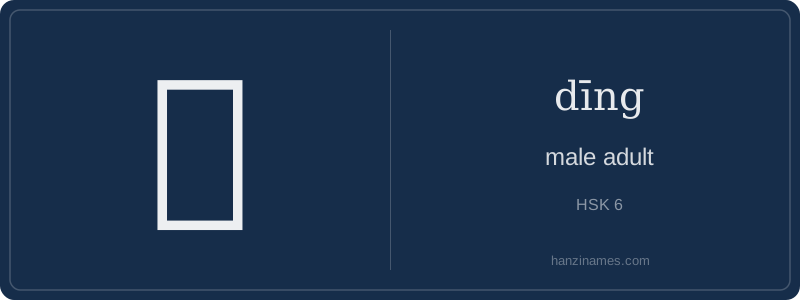
In daily Chinese life, 丁 appears most commonly in fixed expressions and bureaucratic language: 人丁 (réndīng) means ‘household population’, especially in legal or census contexts; 丁忧 (dīngyōu) refers to the traditional mourning period when officials resigned to grieve parents. The term 丁克 (dīngkè), coined in the 1990s, blends ‘DINK’ with 丁, illustrating how this ancient character absorbed modern sociological concepts. It also appears in names (e.g., 丁磊 Dīng Lěi, CEO of NetEase) and the Heavenly Stems calendar system still used alongside the Gregorian calendar.
The earliest attested form of 丁 appears in Shāng dynasty oracle bone inscriptions (c. 1200 BCE) as a square or rectangular shape—likely stylized from a pictograph of a nail or peg (used to fasten things firmly), later simplified to two strokes. This reflects its semantic link to ‘sturdiness’ and ‘readiness’, which evolved into the meaning ‘able-bodied male’.
Hi students! Let’s look at the character 丁 (dīng). Though it has only two strokes, it carries rich historical weight. In ancient China, it originally referred to a ‘male adult capable of labor or military service’—a key demographic for taxation and conscription. Today, it’s rarely used alone in speech, but appears frequently in formal, administrative, or literary contexts. Don’t confuse it with common verbs or adjectives—it’s more of a classical or bureaucratic term.
This character is part of the ‘Heavenly Stems’ (tiāngān), a ten-term cycle used for dating, naming, and astrology—丁 is the fourth stem (e.g., 丁卯 year = 2027). Its minimal form—a horizontal stroke (一) topped by a vertical stroke (丨)—reflects its early oracle bone script origin as a simplified depiction of a nail or peg, symbolizing firmness and readiness—qualities associated with able-bodied men.
At HSK Level 6, 丁 signals advanced vocabulary mastery—not because it’s hard to write, but because its usage is nuanced and context-dependent. You’ll meet it in terms like 丁壮 (dīngzhuàng, ‘able-bodied adults’) or 人丁 (réndīng, ‘population/household members’). It’s also embedded in modern compound words like 丁克 (dīngkè, ‘DINK’—Dual Income, No Kids), showing how classical characters adapt to contemporary life.
Example Sentences
Common Compounds
Similar Characters — Don't Mix These Up
Your First Step into Chinese Culture: Get a Chinese Name
Every journey into Chinese begins with a name. Use our free Chinese name generator to create a meaningful, personalized Chinese name that fits you perfectly.
Get My Chinese Name →