丸
Character Story & Explanation
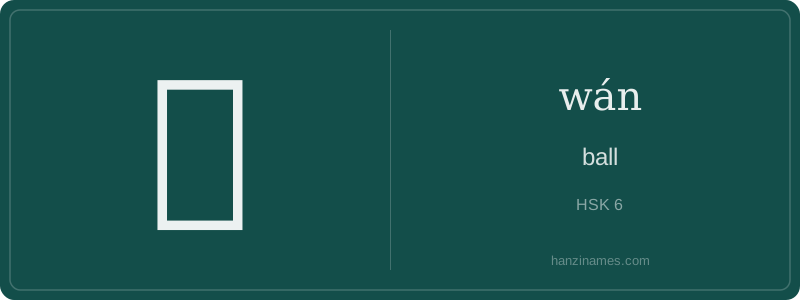
In daily life, 丸 most commonly appears in pharmaceutical contexts: over-the-counter herbal pills sold in traditional Chinese medicine (TCM) clinics across China—like Liu Wei Di Huang Wan (Six-Flavor Rehmannia Pill), a widely prescribed kidney-tonifying formula. It also features in food names such as 鱼丸 (yú wán, fish balls), a staple in Fujian and Taiwan street food culture, often served in soups or skewered and grilled. Historically, 丸 appears in Tang and Song medical texts like the Taiping Huimin Heji Jufang (1082 CE), which cataloged hundreds of pill-based prescriptions.
The character 丸 originated as a stylized depiction of a round object in early clerical script—its three strokes (丶一丿) represent a dot (top), horizontal line (mid-section), and downward stroke (curving base), evoking compact sphericity. While not a direct oracle-bone pictograph, its seal script form () already emphasized rounded containment, later simplified into today’s standard form.
The character 丸 (wán) is a deceptively simple yet culturally rich glyph—just three strokes, yet it carries weight far beyond its minimalist form. Its core meaning 'ball' extends metaphorically to pills (round medicine), dumplings, and even slang for 'perfectly round' or 'neatly wrapped' things. In classical Chinese, 丸 appears in compound words like 金丹丸 (jīndān wán), referring to Daoist alchemical pills believed to grant immortality—a testament to how deeply shape and symbolism intertwine in Chinese thought.
Despite its HSK Level 6 status—indicating advanced vocabulary—it’s rarely used alone in modern speech. Instead, 丸 thrives inside compound nouns: pharmaceutical labels, culinary terms, and idiomatic expressions. You’ll see it on herbal medicine bottles in Beijing pharmacies, in Sichuan hotpot menus listing 'fish paste balls', and even in tech slang like 'app icon' (app图标, though not using 丸 directly, echoes the visual logic of round interface elements).
This character exemplifies how Chinese writing compresses physical form, function, and cultural history into a single unit. Its radical 丶 (dot) hints at centrality or focus—appropriate for something spherical and self-contained. Unlike pictographs with clear ancient origins (e.g., 日 for 'sun'), 丸 evolved from seal script forms representing rounded objects, later standardized during the Qin dynasty’s script unification. Its simplicity belies centuries of medicinal, culinary, and linguistic refinement.
Example Sentences
Common Compounds
Similar Characters — Don't Mix These Up
Your First Step into Chinese Culture: Get a Chinese Name
Every journey into Chinese begins with a name. Use our free Chinese name generator to create a meaningful, personalized Chinese name that fits you perfectly.
Get My Chinese Name →