予
Character Story & Explanation
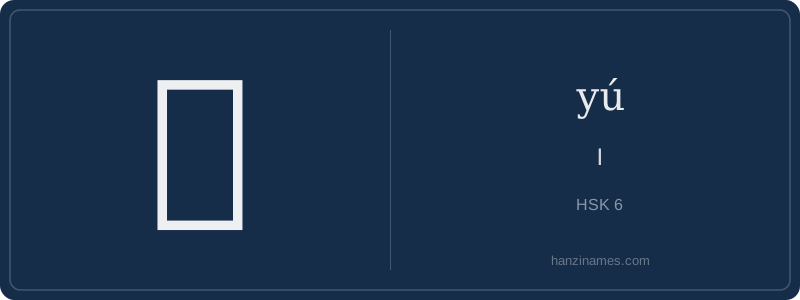
予 is rarely spoken but frequently seen in formal written contexts: official documents (e.g., '本合同予双方具有约束力'), classical poetry, and set phrases like 予取予求 (yǔ qǔ yǔ qiú, 'to take and demand at will'). It appears in the famous phrase from the Mencius: '予岂好辩哉?' ('Do I delight in argument?'). Modern speakers recognize it instantly in legal or ceremonial language—but never say it aloud in daily speech; it’s replaced by 我 (wǒ).
The character’s earliest confirmed form appears in Warring States bamboo slips (4th c. BCE) as a stylized gesture of extension—likely derived from a pictograph of a hand offering something forward. No oracle bone form is verified; its origin is attested first in bronze and bamboo script as a phonosemantic compound where 亅 signals action and the horizontal strokes suggest reciprocity or scope.
Our detective begins at the crime scene: the character 予 (yú). Unlike many pronouns, it doesn’t depict a person or body part—it’s abstract and functional. Early inscriptions show it as a simplified glyph with a hook-like stroke (亅) and three horizontal lines, suggesting an act of *giving* or *extending*—not self-reference. This hints that 予’s core idea isn’t ‘I’ as identity, but ‘I (as agent) bestowing’—a grammatical fossil of classical agency.
Zooming in on the radical 亅 (jié, ‘hook’), we find it appears in only a handful of characters (e.g., 了, 事, 予), often marking decisive action or completion. In 予, the hook anchors the gesture: the top stroke extends forward, the two lower horizontals imply reciprocity or balance. This structure aligns with its classical usage—not as a neutral ‘I’, but as an emphatic, volitional subject: ‘I (hereby) grant…’, ‘I (myself) declare…’.
Modern linguistics confirms 予 is nearly extinct in spoken Mandarin—it survives only in formal writing, legal texts, and literary idioms. Its ‘I’ meaning is archaic and stylistic, not colloquial. Think of it as Mandarin’s ‘ye olde’ pronoun: still legible, legally binding, and occasionally poetic—but never used in texting or conversation. Its persistence reveals how Chinese orthography preserves grammatical layers like geological strata—frozen intention, not living speech.
Example Sentences
Common Compounds
Similar Characters — Don't Mix These Up
Your First Step into Chinese Culture: Get a Chinese Name
Every journey into Chinese begins with a name. Use our free Chinese name generator to create a meaningful, personalized Chinese name that fits you perfectly.
Get My Chinese Name →