亡
Character Story & Explanation
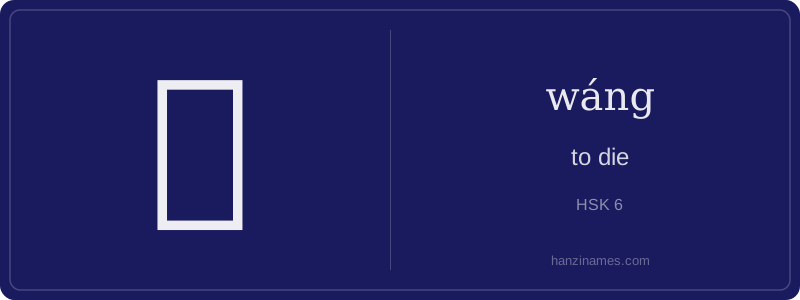
In modern Chinese, 亡 is most commonly encountered in formal writing, news reports on casualties, historical documentaries, and idioms like 亡羊补牢 (wáng yáng bǔ láo, 'mend the fold after the sheep are lost')—a well-documented idiom from the Warring States period (475–221 BCE) recorded in the Yan Zi Chun Qiu. It’s also standard in official terminology: e.g., 因公殉职 (yīn gōng xùnzhí, 'die in the line of duty') often pairs with 亡 in obituaries. You’ll rarely hear it in casual speech—Chinese speakers prefer softer terms like 过世 (guòshì) or 去世 (qùshì).
The earliest confirmed form of 亡 appears in bronze inscriptions (c. 11th–3rd c. BCE), where it resembles a person with arms raised under a cover—possibly symbolizing disappearance or concealment. Scholars agree it evolved from a pictograph representing 'loss' or 'absence', not literal death imagery. Its core semantic idea is 'to be gone', making it broader than just biological death.
Hi students! Let’s look at the character 亡 (wáng), which means 'to die' or 'to perish'. Though simple—just three strokes—it carries deep weight in Chinese. Unlike casual words for 'death', 亡 is formal and often appears in literary, historical, or solemn contexts. It’s not used in everyday speech like 死 (sǐ); instead, it shows up in official documents, classical texts, and idioms. Think of it as the 'dignified' or 'historical' word for death—like saying 'perish' instead of 'die' in English.
This character belongs to HSK Level 6, meaning it’s advanced—but don’t be intimidated! Its simplicity makes it a great anchor for learning compound words. Notice its radical 亠 (tóu), meaning 'cover' or 'top', which hints at something being 'covered over'—a poetic visual metaphor for life ending. Even though it looks plain, every stroke matters: dot, horizontal, then a rising slant. Practice slowly, linking form to meaning.
Remember: 亡 is rarely used alone. You’ll almost always see it in compounds like 亡国 (wángguó, 'fallen state') or 逃亡 (táowáng, 'to flee'). It also appears in legal and historical terms—e.g., 战亡 (zhànwáng, 'killed in battle')—where precision and gravity matter. As you advance, spotting 亡 helps you decode serious, high-register vocabulary. Keep a notebook of 亡-words—you’ll soon recognize patterns across history, law, and literature!
Example Sentences
Common Compounds
Similar Characters — Don't Mix These Up
Your First Step into Chinese Culture: Get a Chinese Name
Every journey into Chinese begins with a name. Use our free Chinese name generator to create a meaningful, personalized Chinese name that fits you perfectly.
Get My Chinese Name →