院
Character Story & Explanation
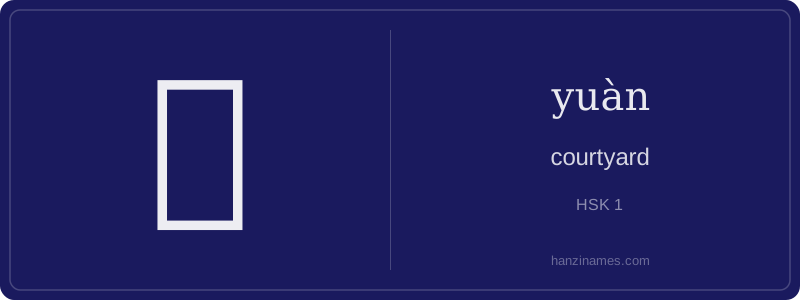
In imperial China, government offices and elite academies were housed in walled courtyard complexes — giving rise to terms like 翰林院 (Hànlín Yuàn, the Hanlin Academy) and 太医院 (Tàiyī Yuàn, the Imperial Medical Institute). Today, 院 remains central to institutional naming: over 95% of Chinese hospitals include 医院, and all universities have at least one 学院 (college/school). The phrase 院子 (yuànzi) still means ‘courtyard’ in everyday speech — especially in northern dialects and Beijing hutong life.
The character evolved from seal script, where the left part resembled a roofed enclosure (宀) over ‘complete’ (完), and the right 阝 represented a settlement. By the Han dynasty, it standardized into its current form — a clear semantic-phonetic compound, not a pictograph.
Hi students! Let’s learn 院 (yuàn), a Level 1 HSK character with just 9 strokes. It originally meant an enclosed courtyard — think of traditional Chinese homes with walls and open spaces in the center. Today, it’s still used for physical courtyards, but more often appears in compound words meaning 'institution' — like hospitals (医院), schools (学院), or research institutes (研究院). Don’t be surprised: this shift happened because many such institutions were historically housed in walled courtyard compounds.
The character contains the radical 阝 (the 'right ear' radical), which almost always relates to places, regions, or settlements — not ears! It’s on the right side, and the left part (完) gives pronunciation clues (though modern yuàn doesn’t sound exactly like wán, there’s historical phonetic linkage). Writing it correctly matters: follow stroke order carefully — start with the left ‘complete’ component before adding the right-side radical.
Because 院 is so common in formal nouns, you’ll see it everywhere — on building signs, official documents, and even subway station names (e.g., 北京协和医院). It’s not used alone in daily speech (you won’t say *‘Let’s go to the yuàn!’*), but mastering it unlocks dozens of essential vocabulary items. Think of it as a ‘building block’ character: small in form, big in function!
Example Sentences
Common Compounds
Similar Characters — Don't Mix These Up
Your First Step into Chinese Culture: Get a Chinese Name
Every journey into Chinese begins with a name. Use our free Chinese name generator to create a meaningful, personalized Chinese name that fits you perfectly.
Get My Chinese Name →