仁
Character Story & Explanation
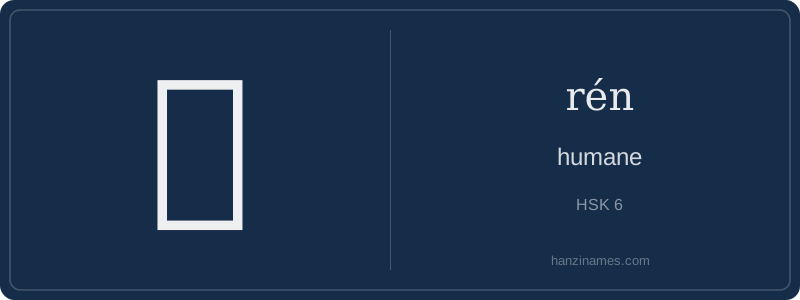
In daily life, 仁 appears most frequently in formal, ethical, or scholarly contexts — rarely in casual speech. It anchors classical idioms like 仁至义尽 (rén zhì yì jìn, 'humane to the utmost, righteous to the end'), used when someone has done everything morally possible. Historically, imperial civil service exams tested candidates’ grasp of 仁 in Confucian classics; emperors issued edicts invoking ‘benevolent rule’ (仁政, rén zhèng). Modern usage persists in education policy (e.g., ‘humanistic education’ 仁爱教育) and medical ethics (医者仁心, yī zhě rén xīn — 'a doctor’s humane heart').
The character’s origin is documented: 仁 evolved from the earlier character 人 (rén, ‘person’) with added 二 (‘two’) — first attested in Warring States manuscripts like the *Guodian Chu Slips* (c. 300 BCE). This reflects its core meaning: humanity realized *between* people — not solitary virtue, but relational responsibility.
As a detective tracing 仁’s evolution, I begin at the crime scene of early Chinese script: no oracle bone or bronze inscriptions contain 仁 — it first appears reliably in Warring States bamboo texts (475–221 BCE), centuries after the earliest writing. Its absence in Shāng and Zhōu inscriptions suggests it emerged not as a pictograph but as a philosophical coinage — a conceptual ‘invention’ rather than a visual imitation. The radical 亻 (person) paired with 二 (two) signals relational ethics: humanity defined not in isolation, but in *betweenness* — how one person treats another.
This duality is no accident. Confucius (551–479 BCE) elevated 仁 to the apex of his moral system, calling it ‘the fullness of human virtue’ — not mere kindness, but empathetic action rooted in ritual propriety (lǐ) and reciprocity (shù). Unlike static virtues like ‘justice’, 仁 is performative: it only exists when enacted — in speech, gesture, governance. Mencius later argued it springs from innate moral sprouts, especially the ‘heart-mind’ (xīn) that recoils at suffering. Thus, 仁 isn’t an attribute; it’s an orientation.
The character’s minimalist form — just four strokes — belies its weight. Its structure is deliberately unadorned: two strokes for the person radical (亻), two for 二 — a stark, balanced glyph. This austerity mirrors Confucian pedagogy: 仁 isn’t learned through rote, but cultivated through daily practice — correcting oneself before judging others, extending care from family outward. Even today, Chinese educators cite Analects 12.1: ‘Mastering oneself and returning to ritual — that is 仁.’ No grand gesture required; just conscious, relational presence.
Example Sentences
Common Compounds
Similar Characters — Don't Mix These Up
Your First Step into Chinese Culture: Get a Chinese Name
Every journey into Chinese begins with a name. Use our free Chinese name generator to create a meaningful, personalized Chinese name that fits you perfectly.
Get My Chinese Name →