仗
Character Story & Explanation
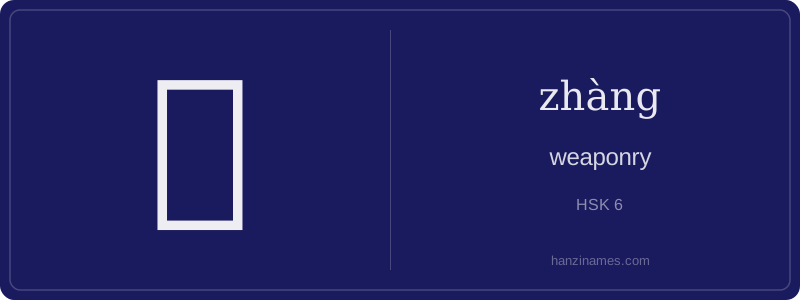
In daily life, 仗 appears most commonly in fixed phrases—not as a standalone noun. The idiom 打仗 (dǎ zhàng) means ‘to fight a war’ and is used in both historical contexts (e.g., 抗日战争, ‘War of Resistance Against Japan’) and figurative ones (e.g., 跟时间打仗, ‘wage war against time’). Another key term is 仪仗队 (yí zhàng duì), the ceremonial honor guard seen at Tian’anmen Square during National Day parades—documented in official PLA regulations and CCTV broadcasts since the 1950s.
The character’s form is not pictographic but phono-semantic: 亻 (person) + 丈 (zhàng, ‘ten feet’ and phonetic component). 丈 itself evolved from oracle-bone script meaning ‘elder’ or ‘measure’, later standardizing as a unit of length. No verified ancient glyph shows a literal weapon—its ‘weaponry’ meaning developed through association with armed personnel and military formations in Zhou and Han dynasty texts like the *Zuo Zhuan*.
Hello students! Let’s explore the character 仗 (zhàng). Though it looks simple—just five strokes and the ‘person’ radical 亻—it carries weighty historical meaning. Originally, it referred to a long polearm used by soldiers in ancient China, like a spear or halberd. The left side (亻) hints at human agency—someone wielding it—while the right side (丈) originally meant ‘ten feet’, suggesting the weapon’s length. Don’t confuse it with modern guns; 仗 is classical, poetic, and still very much alive in idioms and formal writing.
This character rarely stands alone in modern speech—it’s almost always part of compounds like 打仗 (dǎ zhàng, ‘to wage war’) or 仪仗 (yí zhàng, ‘ceremonial guard’). Its usage evokes discipline, authority, and tradition. Even today, you’ll see 仗 in military parades, historical dramas, and political speeches when referencing national defense or righteous struggle. It’s not about violence per se, but about justified action backed by principle or duty.
As an HSK Level 6 word, 仗 appears in advanced reading—especially in literature, news analysis, and official documents. Mastering it helps you grasp nuanced expressions like ‘rely on’ (e.g., 依仗 yī zhàng), where the idea of ‘leaning on a weapon for support’ metaphorically extends to depending on power, influence, or resources. Pay attention to tone: zhàng is fourth tone—sharp and falling—like giving a firm command. Practice writing it slowly: 丿 (piě), 丨 (shù), 一 (héng), 一 (héng), 乚 (shù wān gōu).
Example Sentences
Common Compounds
Similar Characters — Don't Mix These Up
Your First Step into Chinese Culture: Get a Chinese Name
Every journey into Chinese begins with a name. Use our free Chinese name generator to create a meaningful, personalized Chinese name that fits you perfectly.
Get My Chinese Name →