伍
Character Story & Explanation
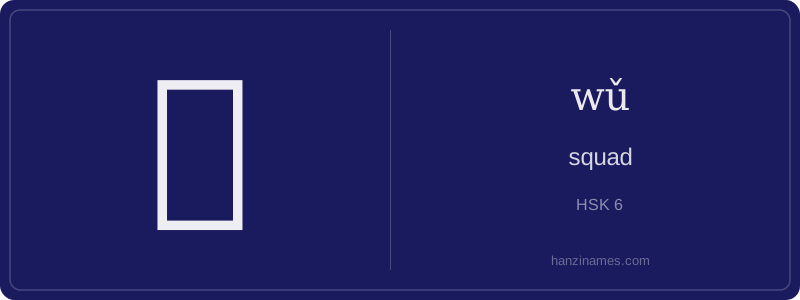
In modern Chinese, 伍 appears most often in military and formal registers: PLA units use terms like ‘班、排、连、营、团、师、军’, but 伍 survives in idioms like 入伍 (rù wǔ, ‘to enlist’) — over 1 million people use this phrase annually in official recruitment notices. Historically, the ‘wu system’ (什伍制) was codified under Qin law: ten households formed a ‘shi’, five a ‘wu’, each held collectively responsible. This system is well-documented in excavated Qin bamboo slips from Shuihudi (1975).
The character’s form is not pictographic but phono-semantic: 亻 (person radical) signals meaning related to people, and 五 (wǔ, ‘five’) provides both sound and conceptual basis — confirming its origin as ‘a group of five people’. No oracle bone form survives, but bronze inscriptions from the Warring States period already show this structure.
Hi students! Let’s learn 伍 (wǔ), a character with just six strokes and the ‘person’ radical 亻 on the left. It originally meant a military unit of five soldiers — think of it as ancient China’s smallest tactical team. Though rarely used alone today, 伍 appears in formal, historical, or administrative contexts, especially when referring to groups, ranks, or collective identity. Its sound wǔ is identical to the number ‘five’ (五), which helps you remember its core idea: grouping by fives.
This character isn’t about counting — it’s about organization and belonging. In classical texts like the *Zuo Zhuan*, ‘伍’ described neighborhood-based mutual surveillance systems where five households formed one unit for tax and defense. That social structure shaped how communities functioned for centuries. So while you won’t hear 伍 in casual chat like ‘five apples’, you’ll see it in solemn, structured settings — like military documents, historical dramas, or formal names.
Don’t confuse 伍 with the number 五 (wǔ) — they sound the same but look and function differently. 伍 is always about people-in-group; 五 is just the numeral. As an HSK Level 6 character, it’s rare but meaningful: mastering it shows deeper cultural literacy. Try writing it slowly: 亻 + 五 — person + five = a squad of five. That visual logic makes it stick!
Example Sentences
Common Compounds
Similar Characters — Don't Mix These Up
Your First Step into Chinese Culture: Get a Chinese Name
Every journey into Chinese begins with a name. Use our free Chinese name generator to create a meaningful, personalized Chinese name that fits you perfectly.
Get My Chinese Name →