佳
Character Story & Explanation
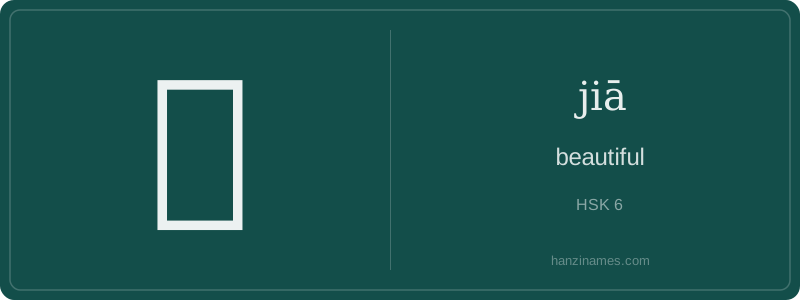
In modern Chinese, 佳 appears frequently in formal and literary contexts: news headlines use 佳音 (jiāyīn, 'good news'), wedding invitations feature 佳期 (jiāqī, 'auspicious date'), and literary reviews praise 佳作 (jiāzuò, 'outstanding work'). It’s also embedded in fixed idioms like 佳偶天成 (jiā ǒu tiān chéng, 'a perfect match ordained by heaven'), documented in Ming-Qing vernacular novels and still used today in marriage announcements.
The character is not pictographic—it emerged during the Warring States period as a phono-semantic compound: 亻 (person radical) + 吉 (jí, 'auspicious', serving as both phonetic and semantic element). Archaeological evidence from bamboo slips (e.g., Tsinghua collection, c. 300 BCE) confirms this structure, with no earlier oracle bone or bronze forms found—its origin is firmly attested in early manuscript traditions.
Our detective begins in the Han dynasty, where 佳 first appears in clerical script inscriptions—not as a pictograph, but as a phono-semantic compound. The left radical 亻 (person) signals human-related qualities; the right component 吉 (jí, 'auspicious') provides both sound and semantic resonance—beauty here is not merely visual, but auspicious, harmonious, and morally pleasing. This reflects early Chinese aesthetics: beauty inheres in virtue and balance, not ornament alone.
By the Tang and Song dynasties, 佳 evolved into a refined literary marker—used in poetry to elevate nouns without redundancy: 佳人 (jiārén, 'excellent person') implied grace and virtue, not just physical charm. Unlike simpler synonyms like 美 (měi), 佳 carries quiet elegance and selectivity—it modifies only what is *truly worthy*: 佳作 (jiāzuò, 'masterpiece'), 佳期 (jiāqī, 'propitious time'). Its tone is respectful, never casual.
Modern usage preserves this dignified restraint. You’ll rarely hear 佳 in slang or spoken Mandarin—it’s reserved for formal writing, classical allusions, and branding that evokes tradition: hotels named 佳苑 (‘Fine Garden’), wine labels bearing 佳酿 (‘exquisite brew’). Its eight strokes form a compact yet balanced structure—symmetrical, grounded by the person radical, and crowned by the auspicious ‘吉’—a visual echo of its meaning: beauty rooted in human virtue and cosmic harmony.
Example Sentences
Common Compounds
Similar Characters — Don't Mix These Up
Your First Step into Chinese Culture: Get a Chinese Name
Every journey into Chinese begins with a name. Use our free Chinese name generator to create a meaningful, personalized Chinese name that fits you perfectly.
Get My Chinese Name →