侈
Character Story & Explanation
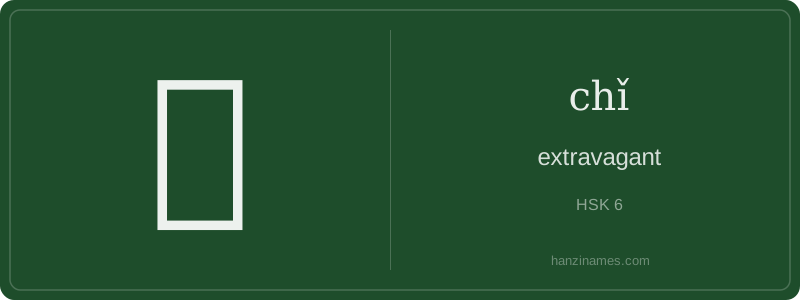
In modern Chinese, 侈 appears most frequently in formal, critical contexts—especially in government white papers, anti-corruption campaigns, and editorial commentary. It’s central to the idiom 侈靡之风 (chǐmí zhī fēng), meaning 'the trend of extravagance', cited in State Council documents since 2013 to condemn wasteful official banquets and luxury gifting. It also appears in classical allusions like 侈言 (chǐ yán)—'grandiose, unfounded talk'—used by journalists to critique political rhetoric.
The character’s written form has no pictographic origin; 乇 is a phonetic component with unclear semantic roots. Historically, it emerged in Warring States bamboo slips as a phonosemantic compound. Today, Chinese learners most commonly encounter it in HSK 6 reading passages about social ethics—e.g., a 2022 Gaokao English-Chinese translation exercise used 侈 to render 'ostentatious display' in a passage on sustainable consumption.
Our detective begins at the crime scene: the character 侈, found in classical texts like the Book of Rites and Mencius, where it consistently flags moral overreach—spending beyond virtue, speech beyond propriety. Its radical 亻 (person) anchors it in human behavior, while the right side 乇 (tuō), though phonetic, subtly echoes ‘to drag down’ or ‘exceed limits’ in ancient phonetic loan usage—hinting that extravagance isn’t just lavishness, but a downward spiral of self-indulgence.
Zooming in on the brushwork: eight clean strokes—two for the person radical, then six forming 乇—reveal disciplined austerity in form contrasting sharply with its meaning. This irony is intentional: Chinese orthography often uses restrained structure to critique excess. Early seal script shows 侈 already standardized by the Qin dynasty, proving its conceptual weight was established early—not as slang, but as a Confucian ethical marker against decadence.
Forensic linguistics confirms 侈 never meant ‘abundant’ or ‘prosperous’—those are covered by 富 (fù) or 盛 (shèng). Instead, 侈 always carried judgment: it’s the *moral surplus*—when wealth, words, or desires spill past social or ritual boundaries. Even today, its presence in official discourse signals censure: CCTV news reports on ‘excessive consumption’ use 侈 not descriptively, but prescriptively—as a red flag for policy correction.
Example Sentences
Common Compounds
Similar Characters — Don't Mix These Up
Your First Step into Chinese Culture: Get a Chinese Name
Every journey into Chinese begins with a name. Use our free Chinese name generator to create a meaningful, personalized Chinese name that fits you perfectly.
Get My Chinese Name →