侵
Character Story & Explanation
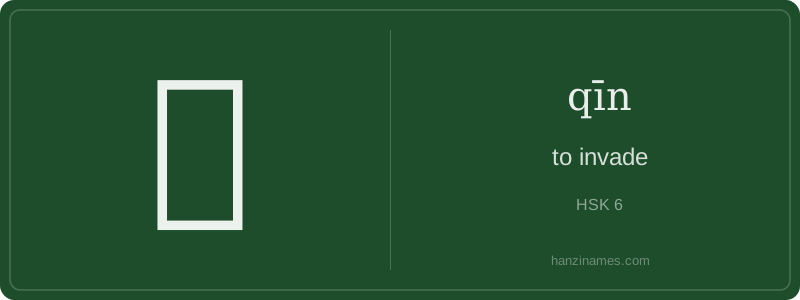
In contemporary Chinese media and policy documents, 侵 most commonly appears in compound terms like 侵略 (qīnlüè, 'aggression'), 侵犯 (qīnfàn, 'to infringe'), and 侵占 (qīnzhàn, 'to illegally occupy'). It features prominently in China’s Cybersecurity Law (2017), which prohibits ‘any act that invades network security’ (入侵网络系统). The term 侵华日军 (qīn huá rì jūn, 'Japanese troops who invaded China') is a fixed historical phrase taught in all middle-school history textbooks, referencing the 1931–1945 period.
The character’s seal script form (c. 3rd century BCE) combines 亻 (person) and 彐 (a simplified variant of 貝, originally representing wealth or territory). By Han Dynasty bamboo slips, it consistently denoted unauthorized entry into land or jurisdiction — not mythic origins, but documented administrative usage for border control and property disputes.
The character 侵 (qīn) evokes images of boundary violations — not just military invasions, but subtle, creeping encroachments. In modern China, it appears in news headlines about foreign tech firms ‘invading’ domestic markets or invasive species disrupting ecosystems near the Yangtze River. Its human radical (亻) signals agency: people acting — often uninvited — upon others’ space, rights, or stability.
Historically, 侵 carried legal and diplomatic weight: during the Ming Dynasty, border officials used it to document ‘unauthorized incursions’ by nomadic groups into agricultural zones — a term implying violation without full-scale war. Today, it retains that nuance: less explosive than 伐 (to attack militarily), more deliberate than 闯 (to barge in). It suggests sustained, systematic pressure.
Even in daily life, 侵 surfaces in quiet tensions: a neighbor’s tree roots ‘invading’ your foundation (根系侵入地基), or algorithms ‘invading’ privacy (算法侵入隐私). Unlike blunt force, 侵 implies erosion — slow, hard to reverse, and often legally contested. That layered gravity is why it appears only at HSK Level 6: learners must grasp not just vocabulary, but cultural thresholds of consent, sovereignty, and coexistence.
Example Sentences
Common Compounds
Similar Characters — Don't Mix These Up
Your First Step into Chinese Culture: Get a Chinese Name
Every journey into Chinese begins with a name. Use our free Chinese name generator to create a meaningful, personalized Chinese name that fits you perfectly.
Get My Chinese Name →