俘
Character Story & Explanation
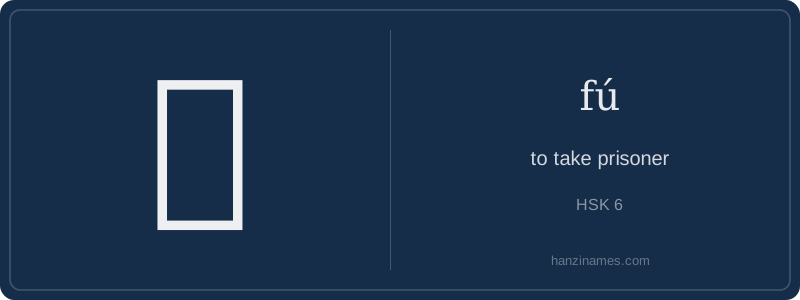
In modern Chinese, 俘 is primarily used in formal, historical, or legal contexts—not daily conversation. It appears in official media reports on military history (e.g., PLA accounts of capturing Nationalist soldiers in 1949), in textbooks discussing the Geneva Conventions, and in idioms like 俘虏人心 (fúlǔ rénxīn, 'to win people’s hearts'), metaphorically extending 'captivity' to persuasion and influence. The term 俘获 (fúhuò, 'to capture and secure') is common in cybersecurity and marketing jargon, reflecting semantic broadening.
The character’s form is not pictographic but phono-semantic: 亻 (person) + 甫 (fǔ, phonetic). Archaeological evidence confirms 俘 first appeared in bronze inscriptions of the Western Zhou (c. 1046–771 BCE), consistently meaning 'to seize a person in battle'. No oracle-bone form survives, but early usage in the *Book of Documents* (Shūjīng) documents its role in legitimizing dynastic transitions through righteous capture of tyrants.
The character 俘 (fú) embodies a profound cultural awareness of power, restraint, and the human condition in conflict. Unlike English’s neutral 'capture', 俘 carries implicit moral weight—suggesting not just physical seizure but the suspension of agency, dignity, and autonomy. In classical Chinese military thought, taking prisoners was never merely tactical; it reflected the victor’s virtue (德), as humane treatment of captives demonstrated benevolent authority—a key Confucian ideal for legitimate rule.
This worldview is embedded in the character’s structure: the 亻 (person) radical anchors it in human experience, while the phonetic component 甫 (fǔ) historically evoked ‘beginning’ or ‘foundation’, subtly framing captivity as a pivotal, transformative moment—not an endpoint. Thus, 俘 invites reflection on how societies define justice, mercy, and rehabilitation in wartime, revealing Chinese ethics’ emphasis on moral consequence over brute force.
Even today, 俘 appears in contexts that signal ethical reckoning: official discourse on wartime conduct, historical education about WWII POW treatment, and legal texts governing prisoner rights under Chinese law. Its HSK-6 status reflects its specialized, high-register usage—rare in casual speech but vital in academic, diplomatic, and historical domains. This mirrors China’s broader civilizational stance: strength must be tempered by ritual propriety (礼) and humane governance (仁政), making 俘 less a word for conquest than a lens into ethical statecraft.
Example Sentences
Common Compounds
Similar Characters — Don't Mix These Up
Your First Step into Chinese Culture: Get a Chinese Name
Every journey into Chinese begins with a name. Use our free Chinese name generator to create a meaningful, personalized Chinese name that fits you perfectly.
Get My Chinese Name →