俯
Character Story & Explanation
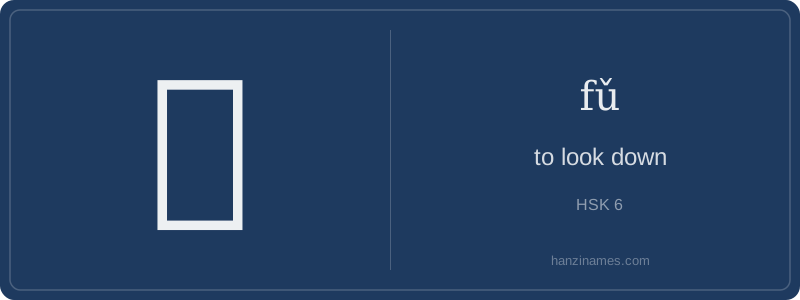
In daily life, 俯 is rarely used alone but thrives in compound verbs and literary expressions. It appears in HSK 6 vocabulary like 俯瞰 (fǔkàn, 'to overlook from above') and idioms such as 俯首帖耳 (fǔshǒu tiē’ěr, 'to bow one’s head and press one’s ears close'—meaning total submission). Historically, it features in Tang dynasty poetry (e.g., Du Fu’s lines describing gazing down from city walls) and Ming-Qing legal documents where officials ‘bowed low’ (俯首) before imperial edicts.
The character’s form is not pictographic—it evolved from seal script where 亻 + 付 coalesced around the 3rd century BCE. 付 was already a standardized phonetic component by then; no oracle bone form exists for 俯. Instead, think of a modern university student writing an essay on urban planning, using 俯瞰 to describe drone footage of Shanghai’s skyline—a real, frequent context where 俯 conveys authoritative yet detached observation.
As a linguistic detective, I begin at the scene: the character 俯 (fǔ), with its 10 strokes and radical 亻 (the 'person' radical). This tells us immediately that the action involves a human subject—someone performing a bodily movement. The right side, 付, is a phonetic component (fù → fǔ, with tone shift), but more crucially, it anchors the character in meaning: 付 carries connotations of 'handing over' or 'submitting', subtly reinforcing the idea of lowering oneself—not just physically, but hierarchically or deferentially.
Zooming in on historical inscriptions, 俯 appears consistently from the Warring States bamboo slips onward, always paired with verbs of posture or perception: 俯視 (fǔshì, 'to look down upon'), 俯首 (fǔshǒu, 'to bow one’s head'). Unlike pictographic characters like 日 (sun) or 山 (mountain), 俯 isn’t a visual snapshot—it’s a *gestural abstraction*: the human figure (亻) bending *into* an act of submission or scrutiny. Its structure encodes intentionality, not just optics.
The tonal evolution—from Middle Chinese /pʰjuX/ to modern fǔ—mirrors its semantic gravity: a falling tone (4th tone) mirrors the downward motion it describes. In classical texts like the *Zuo Zhuan*, 俯 appears in diplomatic contexts where envoys ‘lower their gaze’ to signal respect—or conceal intent. This duality—humble observation versus strategic surveillance—has persisted into modern usage, making 俯 a quiet powerhouse of social nuance, far beyond simple ‘looking down’.
Example Sentences
Common Compounds
Similar Characters — Don't Mix These Up
Your First Step into Chinese Culture: Get a Chinese Name
Every journey into Chinese begins with a name. Use our free Chinese name generator to create a meaningful, personalized Chinese name that fits you perfectly.
Get My Chinese Name →