伪
Character Story & Explanation
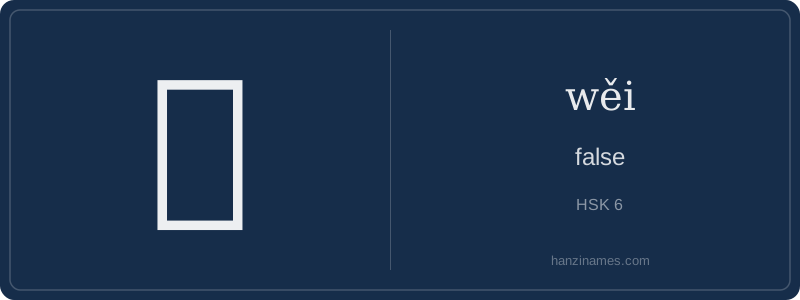
伪 is widely used in modern Chinese legal, technological, and social discourse—especially in phrases like 伪劣产品 (wěi liè chǎnpǐn, 'substandard and counterfeit goods'), a term enshrined in China’s Product Quality Law (1993, revised 2000). It also appears in cybersecurity contexts (e.g., 伪基站, wěi jīzhàn, 'fake base station' used for telecom fraud), reflecting real-world regulatory concerns. The idiom 伪君子 (wěi jūnzǐ) — 'false gentleman' — remains a potent cultural critique of hypocrisy, rooted in Ming-Qing moral literature and still deployed in political commentary today.
The character is a phono-semantic compound: radical 亻 (person) + phonetic 韦 (wéi, originally meaning 'tanned leather', later borrowed for sound). Its earliest attested form appears in seal script (c. 3rd c. BCE), not oracle bones. The 亻 radical signals human agency—emphasizing that falsehood here is *intentionally produced*, not accidental.
The Chinese character 伪 (wěi) conveys the core idea of 'false', 'counterfeit', or 'artificial'—not merely factual inaccuracy, but intentional deception or fabricated legitimacy. Unlike English 'false', which can be neutral (e.g., 'false premise'), 伪 carries a strong moral or ontological weight: something that *pretends* to be authentic while lacking genuine origin or substance. It appears in formal, legal, and philosophical contexts, especially where authenticity, authority, or truth claims are at stake.
In classical Chinese thought, 伪 contrasts with 诚 (chéng, 'sincerity') and 自然 (zìrán, 'spontaneity/nature')—notably in Xunzi’s philosophy, where he argues human nature is inherently inclined toward disorder and must be shaped by ritual (li) and artifice (伪), making 伪 ethically neutral or even necessary for moral cultivation. This nuanced view differs sharply from Western binaries like 'natural vs. artificial', where 'artificial' often implies inferiority.
Western equivalents like 'fraudulent', 'spurious', or 'apocryphal' capture parts of 伪—but none fully encompass its dual capacity for moral condemnation (e.g., 伪君子, 'hypocrite') and philosophical affirmation (e.g., Xunzi’s constructive 伪). Even 'fake' falls short: it’s colloquial and lacks the lexical gravity or historical depth of 伪, which appears in imperial edicts, anti-counterfeiting laws, and Confucian debates—not just slang or marketing warnings.
Example Sentences
Common Compounds
Similar Characters — Don't Mix These Up
Your First Step into Chinese Culture: Get a Chinese Name
Every journey into Chinese begins with a name. Use our free Chinese name generator to create a meaningful, personalized Chinese name that fits you perfectly.
Get My Chinese Name →