债
Character Story & Explanation
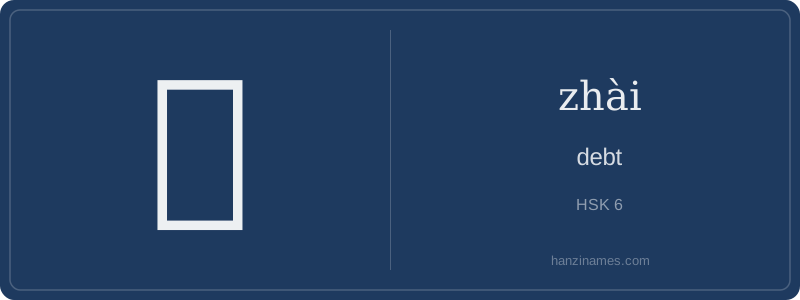
债 appears frequently in modern Chinese legal, financial, and literary contexts. It’s central to terms like ‘债权’ (creditor’s rights) and ‘债务人’ (debtor), both defined in China’s Civil Code (2021). The idiom ‘借债还钱,天经地义’ (jiè zhài huán qián, tiān jīng dì yì)—‘borrowing money and repaying it is heaven-ordained righteousness’—is widely cited in courts and media to affirm contractual integrity. Historically, ‘债’ was used in Tang dynasty legal documents to denote enforceable obligations, distinct from informal favors.
The character combines 亻 (person radical) and 责 (zé, ‘to demand; responsibility’), first appearing in standardized clerical script during the Han dynasty. Its structure visually encodes the idea that debt arises between people and entails duty—a semantic composition confirmed by Shuōwén Jiězì (121 CE), which defines it as ‘what one must repay after receiving something’.
The character 债 (zhài) embodies more than financial obligation—it reflects the Confucian weight of moral reciprocity. In traditional Chinese thought, debt is rarely neutral; it carries social gravity, implying trust, responsibility, and relational continuity. Unlike Western notions where debt can be transactional and impersonal, 债 often evokes a sense of *renqing* (human sentiment/debt of goodwill), binding people across time and circumstance.
This worldview surfaces in idioms like ‘人情债’ (rénqíng zhài)—a ‘debt of human feeling’—which underscores how favors, kindness, or hospitality create invisible but binding obligations. Such debts are not recorded in ledgers but remembered in conduct: returning a favor years later, offering shelter to a friend’s child, or speaking well of someone who once advocated for you.
Even modern usage retains this ethical resonance. Government discourse on ‘国家债务’ (guójiā zhàiwù, national debt) subtly invokes collective accountability—not just fiscal risk, but intergenerational trust. When a young adult says ‘我欠父母太多债’ (I owe my parents too much debt), they’re naming filial piety as an unrepayable moral ledger. Thus, 债 reveals how Chinese culture intertwines economics, ethics, and emotional kinship into one ideographic concept.
Example Sentences
Common Compounds
Similar Characters — Don't Mix These Up
Your First Step into Chinese Culture: Get a Chinese Name
Every journey into Chinese begins with a name. Use our free Chinese name generator to create a meaningful, personalized Chinese name that fits you perfectly.
Get My Chinese Name →