僵
Character Story & Explanation
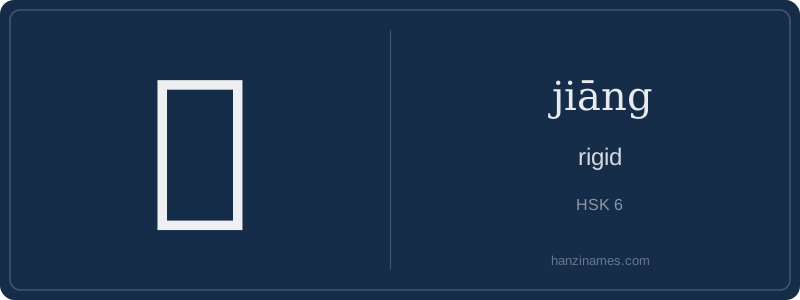
僵 appears frequently in modern Chinese media and official discourse, especially in phrases like 僵局 (jiāngjú, 'deadlock') and 僵持 (jiāngchí, 'to be deadlocked'). It’s widely used in political reporting—for example, describing stalled trade talks or diplomatic standoffs. The idiom 僵尸 (jiāngshī, 'zombie') also stems from this character, historically rooted in Qing-dynasty folklore where corpses were believed to stiffen and reanimate. Today, it’s common in pop culture, horror films, and even internet slang ('I’m a zombie after that exam!').
The character’s form isn’t pictographic—it evolved from seal script around the Warring States period. Its right side combines 弓 (bow), 虫 (insect/worm), and 工 (work), but scholars agree this is phonetic-semantic compound, not a literal image. So instead, think of real life: when a student freezes mid-sentence during an oral exam—mouth open, shoulders tight—that’s 僵.
Hi students! Let’s learn 僵 (jiāng), a Level 6 HSK character meaning 'rigid', 'stiff', or 'frozen'—not just physically, but often emotionally or situationally. It’s built with the 亻(person) radical on the left, showing it relates to human states, and the right side 强 (qiáng, 'strong') hints at intensity—so imagine a person frozen in place by overwhelming force or tension. This isn’t about gentle stiffness; it’s dramatic, sometimes alarming rigidity.
Notice its 15 strokes—practice slowly: start with the two-dot radical 亻, then move to the complex right component (弓 + 虫 + 工). Don’t rush! Each stroke matters for balance. Because it’s HSK 6, you’ll mostly meet 僵 in advanced contexts: literature, news, idioms—not everyday small talk. But once you master it, you’ll understand subtle descriptions of僵局 (jiāngjú, 'deadlock') or 僵持 (jiāngchí, 'to be at an impasse').
Remember: 僵 is never neutral. It carries weight—like muscles locking during shock, negotiations freezing, or laughter turning stiff with awkwardness. Unlike simpler words like 硬 (yìng, 'hard'), 僵 implies loss of flexibility *and* agency. Think of it as ‘rigid to the point of paralysis’. That nuance is key—and why it appears in formal writing, not casual chats. Keep this feeling in mind: not just ‘stiff’, but ‘stuck’.
Example Sentences
Common Compounds
Similar Characters — Don't Mix These Up
Your First Step into Chinese Culture: Get a Chinese Name
Every journey into Chinese begins with a name. Use our free Chinese name generator to create a meaningful, personalized Chinese name that fits you perfectly.
Get My Chinese Name →