拟
Character Story & Explanation
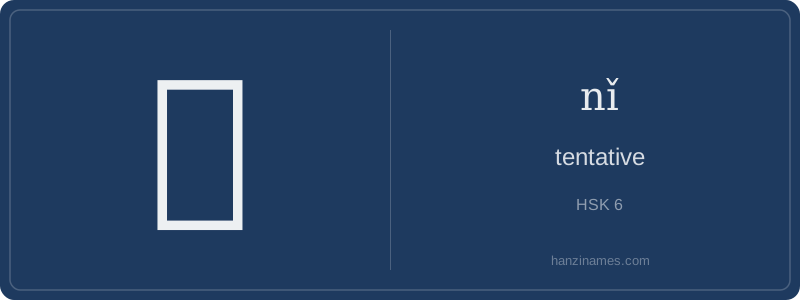
In modern Chinese, 拟 is indispensable in formal and bureaucratic language — especially in government documents, legal drafts, and academic proposals. It signals provisional status: 拟录用 (nǐ lùyòng) means ‘provisionally hired’, and 拟稿 (nǐ gǎo) means ‘to draft a document’. A well-documented usage appears in China’s State Council notices, where phrases like ‘拟于2024年实施’ (‘to be implemented in 2024, pending approval’) are standard. It also appears in idioms like 拟于不伦 (nǐ yú bù lún), meaning ‘inappropriate comparison’, though rare in speech.
The character’s origin is documented: 拟 evolved from 尼 + 扌 in seal script, with 尼 acting phonetically and 扌 semantically (hand-related action). It originally meant ‘to imitate closely’ — not a pictograph, but a phono-semantic compound. No oracle bone form survives; earliest attestation is in Warring States bamboo slips, consistently conveying ‘matching’ or ‘modeling after’.
As a detective tracing 拟’s evolution, I begin at the crime scene: the character’s modern form. At first glance, it seems to accuse itself — its left-hand radical 扌 (hand) suggests action, yet its right side 以 looks suspiciously like a simplified ‘already’ or ‘with’. But here’s the twist: 拟 was never about doubt in ancient times. In early seal script, it depicted ‘to copy with the hand’ — a scribe’s meticulous imitation, not hesitation. The semantic shift from ‘imitate’ to ‘doubtful’ is subtle but logical: when something is merely *proposed* or *drafted*, it carries inherent tentativeness.
My investigation leads me to classical texts like the Shuōwén Jiězì (100 CE), where 拟 is defined as ‘to compare, to match, to imitate’ — no trace of skepticism. The ‘doubtful’ meaning emerged later, via grammaticalization: when used as a verb prefix (e.g., 拟定 ‘to draft a plan’), the act implies provisional status, hence epistemic uncertainty. By the Ming-Qing dynasties, writers like Pu Songling used 拟 in contexts like ‘so-called’ or ‘alleged’, planting seeds for today’s HSK 6 nuance.
This character doesn’t wear its meaning on its sleeve — it hides in plain sight. Its ‘doubtful’ sense is a linguistic alibi: not a direct definition, but a pragmatic inference drawn from context. Like a detective relying on circumstantial evidence, Chinese speakers infer tentativeness from how 拟 modifies nouns (e.g., 拟议中的方案 — ‘a plan under discussion’) or verbs (e.g., 拟赴美 — ‘intends to go to the U.S.’). Its power lies not in declaration, but in implication — making it one of Mandarin’s most elegantly evasive characters.
Example Sentences
Common Compounds
Similar Characters — Don't Mix These Up
Your First Step into Chinese Culture: Get a Chinese Name
Every journey into Chinese begins with a name. Use our free Chinese name generator to create a meaningful, personalized Chinese name that fits you perfectly.
Get My Chinese Name →