兆
Character Story & Explanation
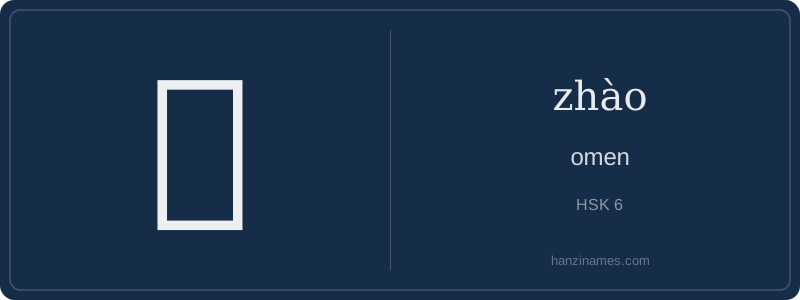
兆 appears frequently in formal and literary contexts to denote auspicious or inauspicious signs—especially in historical records, classical poetry, and modern idioms like 吉兆 (jí zhào, 'auspicious omen') and 凶兆 (xiōng zhào, 'ominous sign'). It’s common in news headlines describing political or economic turning points ('改革出现新兆头', 'new signs of reform'). The character also survives in technical usage: in computing and finance, 兆 means 'trillion' (10¹²), a modern semantic extension from its ancient sense of 'vast, incalculable sign'—documented since the Song dynasty in mathematical texts like The Mathematical Classic of Sun Zi.
The character 兆 originated as a pictograph in bronze inscriptions (c. 11th–3rd century BCE), depicting cracks formed in turtle plastrons during Shang dynasty divination rituals—literally the 'signs' read by oracle-bone scribes. These fissures were interpreted as heaven’s response to questions posed by kings, making 兆 one of the earliest written symbols tied explicitly to cosmological communication.
兆 (zhào) opens a window into the Chinese worldview where signs and patterns in nature are not random but meaningful—portents woven into the fabric of reality. Unlike Western notions of fate as fixed, 兆 reflects a dynamic, responsive cosmos: an omen is not destiny, but an invitation to awareness, adjustment, and moral readiness. This resonates with Confucian emphasis on situational wisdom and Daoist sensitivity to subtle shifts—where a crack in the ice or a sudden bird flight might signal deeper change.
In classical Chinese thought, omens were studied by court astronomers and historians as part of 'heaven-human resonance' (天人感应). A 兆 was never isolated—it gained meaning only in context: time, place, ruler’s virtue, and collective conduct. Thus, 兆 embodies relational epistemology: knowledge arises not from abstraction, but from observing how phenomena interweave. This contrasts sharply with mechanistic causality, privileging harmony over control.
Even today, 兆 lingers in modern Chinese not as superstition but as cultural grammar—a linguistic echo of attentiveness. When people say ‘有兆头’ (yǒu zhàotou, 'there are signs'), they’re not predicting fortune-telling outcomes but acknowledging emerging patterns: rising tensions before a conflict, early enthusiasm before a trend takes off. In this way, 兆 sustains a quiet, enduring philosophy: the world speaks—if we cultivate the stillness to hear its first whispers.
Example Sentences
Common Compounds
Similar Characters — Don't Mix These Up
Your First Step into Chinese Culture: Get a Chinese Name
Every journey into Chinese begins with a name. Use our free Chinese name generator to create a meaningful, personalized Chinese name that fits you perfectly.
Get My Chinese Name →