冤
Character Story & Explanation
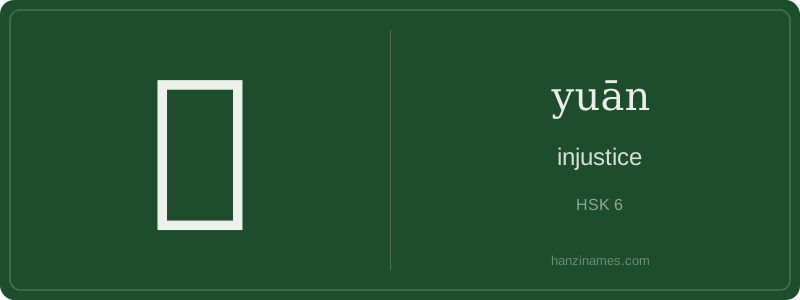
冤 is central to China’s legal discourse and public consciousness. It appears in the official phrase 冤假错案 (yuān jiǎ cuò àn)—‘wrongful, fabricated, and erroneous cases’—a key focus of judicial reforms since the 2010s; multiple high-profile exonerations (e.g., the 2016 Nie Shubin case) were publicly framed as rectifying ‘long-standing 冤’.
Graphically, 冤 is a phono-semantic compound: radical 冖 (a covering, implying suppression) + phonetic 羊 (yáng, providing sound cue; note tone shift to yuān). No oracle-bone or bronze inscriptions survive for this character—it first appears reliably in Han dynasty texts. Today, people commonly write it in petition letters, online complaints, or protest banners demanding accountability for unfair treatment.
The character 冤 (yuān) embodies a profound cultural sensitivity to moral injury—not just legal error, but the deep wound of being wronged without recourse. In traditional Chinese thought, injustice disrupts cosmic harmony (tiān lǐ, 'heavenly principle') and social trust. Unlike Western notions centered on procedural fairness, 冤 emphasizes the victim’s visceral suffering and the community’s moral responsibility to redress it—reflected in centuries of folk operas, legal petitions, and ancestral rites seeking posthumous exoneration.
This concept is inseparable from Confucian ethics: a ruler who permits 冤 loses the Mandate of Heaven; a judge who ignores it violates rén (benevolence) and yì (righteousness). The character itself visually conveys entrapment—'roof' (冖) over 'sheep' (羊), symbolizing the innocent crushed beneath authority. Its emotional weight exceeds mere 'unfairness'; it evokes shame, silence, and intergenerational grief when justice remains unattainable.
Modern usage reveals enduring resonance: from Weibo hashtags like #我冤 (#I’mWronged) documenting workplace or bureaucratic injustices, to court rulings citing 'avoiding 冤假错案' ('miscarriages of justice') as a judicial priority. The term appears in official policy documents since the 1980s reform era, signaling state acknowledgment that restoring dignity after 冤 is essential for social stability—not just legal correctness.
Example Sentences
Common Compounds
Similar Characters — Don't Mix These Up
Your First Step into Chinese Culture: Get a Chinese Name
Every journey into Chinese begins with a name. Use our free Chinese name generator to create a meaningful, personalized Chinese name that fits you perfectly.
Get My Chinese Name →