削
Character Story & Explanation
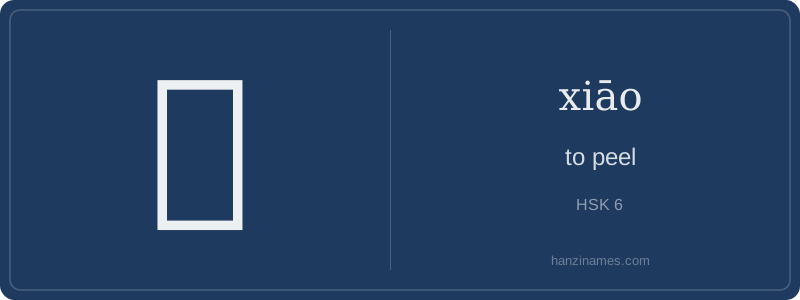
削 is widely used in daily life: students sharpen pencils (削铅笔, xiāo qiānbǐ), chefs peel vegetables (削土豆, xiāo tǔdòu), and officials implement austerity measures (削减开支, xuējiǎn kāizhī). It appears in the classical idiom 削足适履 (xiāo zú shì lǚ), recorded in the Warring States text *Han Feizi*, warning against distorting truth to fit dogma. Modern media frequently uses 削 in economic reporting—e.g., 'the government plans to 削减 subsidies.'
The character evolved from seal script, where the right side 肖 (xiāo) was already phonetic, and the left side 刂 (knife radical) clarified meaning. No pictographic origin survives, but its structure consistently signals 'knife-mediated reduction' across 2,000+ years of documented use—from bamboo slip inscriptions to contemporary news headlines.
The Chinese character 削 (xiāo) primarily means 'to peel, pare, or shave off with a knife'—a precise, controlled cutting action. Unlike broad English verbs like 'cut' or 'slice,' 削 implies removing thin outer layers: apple skins, pencil leads, or calligraphy brush tips. Its radical 刂 (knife) visually anchors this meaning, while the phonetic component 肖 suggests pronunciation. This precision reflects traditional Chinese craftsmanship values—where refinement and subtlety matter more than force.
削 has a second reading, xuē, used in abstract, often negative contexts like 'to reduce' or 'to suppress'—e.g., 削减 (xuējiǎn, 'to cut back [budgets]'). This duality mirrors how physical actions metaphorically extend into social domains: just as a knife removes excess material, authority may 'shave away' rights or resources. Such semantic layering is common in high-level HSK characters, where context determines both tone and moral valence.
In Western equivalents, 'paring' (as in paring knife) comes closest to xiāo’s tactile specificity—but lacks its cultural resonance. A French économe or German Sparschäler serves the same function, yet neither carries 削’s lexical weight in idioms like 削足适履 ('cut feet to fit shoes'—forcing reality into rigid frameworks). This illustrates how Chinese characters encode philosophy within grammar: a single glyph bridges kitchen chore, bureaucratic critique, and classical allusion.
Example Sentences
Common Compounds
Similar Characters — Don't Mix These Up
Your First Step into Chinese Culture: Get a Chinese Name
Every journey into Chinese begins with a name. Use our free Chinese name generator to create a meaningful, personalized Chinese name that fits you perfectly.
Get My Chinese Name →