剖
Character Story & Explanation
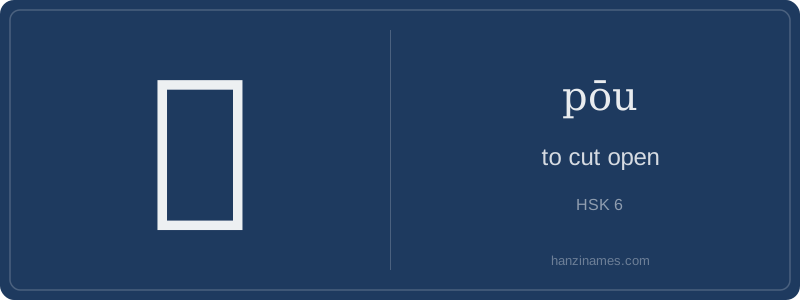
In modern Chinese, 剖 appears frequently in medical contexts (e.g., 剖腹产 'cesarean delivery') and analytical language (e.g., 剖析社会问题 'analyze social issues'). It’s central to HSK 6 vocabulary due to its abstract extension beyond literal cutting. The idiom 披荆斩棘 (pī jīng zhǎn jí) doesn’t contain 剖, but 剖析 (pōu xī) — 'to dissect/analyze' — is a high-frequency academic and media term documented in the 2019《现代汉语词典》7th edition and widely used in official Xinhua News Agency reports.
The character evolved from seal script (c. 3rd c. BCE), where it clearly combines 刀 (knife) and 陪 as phonetic. While not a pictograph, its structure has remained stable since Han dynasty bamboo slips. Today, Chinese students learn it in Grade 10 biology when studying anatomical dissection — making 剖 a bridge between scientific literacy and linguistic precision.
At first glance, 割 (pōu) means 'to cut open' — a physical act of incision. Yet in Chinese thought, cutting open is never merely mechanical; it’s an epistemological gesture. To剖 is to reveal what lies hidden beneath surface appearances — whether flesh, text, or social reality. This reflects the classical Confucian and Daoist value of discernment: truth resides not in the obvious, but in layered truths accessed only through careful, respectful dissection.
The radical 刂 (knife) anchors 剖 in embodied action, while the phonetic component 陪 (péi) subtly evokes companionship and proximity — suggesting that true understanding requires standing close enough to witness inner structure. Unlike Western binaries of surface/depth, 剖 implies relational intimacy: one does not dominate the object cut, but enters dialogue with its interior logic.
This worldview surfaces in medicine (剖腹产, cesarean section), literary criticism (剖析文本), and even political discourse (剖析问题). The character embodies a cultural preference for diagnosis before prescription — a belief that clarity emerges not from judgment, but from precise, ethical exposure. In this light, 剖 is less about violence and more about reverence for hidden order.
Example Sentences
Common Compounds
Similar Characters — Don't Mix These Up
Your First Step into Chinese Culture: Get a Chinese Name
Every journey into Chinese begins with a name. Use our free Chinese name generator to create a meaningful, personalized Chinese name that fits you perfectly.
Get My Chinese Name →