劈
Character Story & Explanation
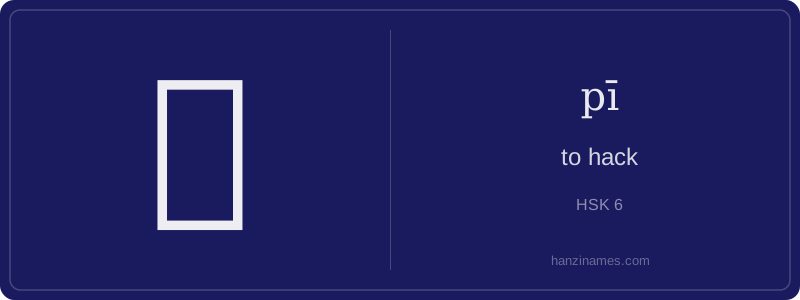
劈 is widely used in modern Chinese for vivid, energetic actions—especially in sports commentary (e.g., table tennis: ‘他劈长球!’), martial arts training, and cooking shows ('劈柴' for firewood-splitting). A well-documented idiom is 劈头盖脸 (pī tóu gài liǎn), recorded in Ming-Qing vernacular fiction, meaning 'to hit someone full-on', now used metaphorically for harsh criticism. It’s also central in the famous Beijing Opera phrase '劈叉' (pīchā, 'split'), though here it’s borrowed phonetically for the leg-splits movement.
The character’s earliest attested form appears in clerical script (Lìshū) from the Han dynasty, where it clearly combines the semantic element 刀 (knife) with phonetic component 辟 (bì/pì)—a common sound-based component. No oracle bone or bronze inscriptions survive for 劈; it emerged later as a specialized derivative meaning 'to split forcibly with a blade'.
Hi students! Today we’re learning 劈 (pī), a dynamic verb meaning 'to hack' or 'to split with a sharp downward motion'. It’s not just about chopping wood—it conveys force, precision, and sudden division. Think of an axe cleaving through bamboo or a martial artist splitting a board with one strike. Though it looks complex (15 strokes!), its radical 刀 (dāo, 'knife') tells us right away it’s action-oriented and weapon- or tool-related.
This character appears mainly in verbs and compound words—not as a standalone noun—and is almost always transitive (it needs an object). Its second pronunciation pǐ is rare and mostly found in classical or literary contexts, like the idiom 劈头盖脸 (pī tóu gài liǎn, 'slap in the face'—figuratively, an overwhelming, direct assault).
Don’t confuse 劈 with similar-looking characters like 壁 (bì, 'wall') or 臂 (bì, 'arm'). Remember: if you see 刀 on the right and two 'open hands' (the top part resembles 手 + 手), you’re looking at 劈—the visual suggests two hands gripping a blade to deliver a powerful downward cut. Practice writing it slowly, stroke by stroke, paying attention to the balanced symmetry of the upper components over the decisive knife radical.
Example Sentences
Common Compounds
Similar Characters — Don't Mix These Up
Your First Step into Chinese Culture: Get a Chinese Name
Every journey into Chinese begins with a name. Use our free Chinese name generator to create a meaningful, personalized Chinese name that fits you perfectly.
Get My Chinese Name →