勉
Character Story & Explanation
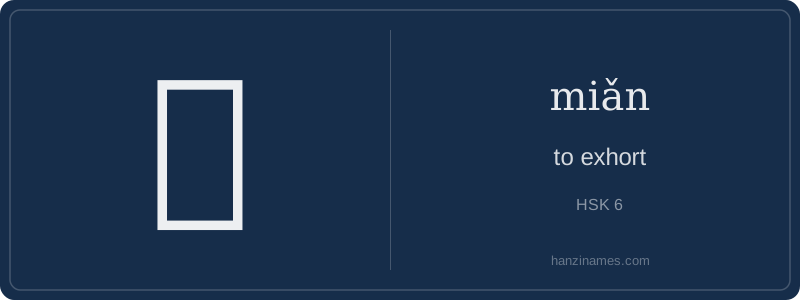
In modern Chinese, 勉 appears most frequently in formal, written, or elevated spoken contexts—especially in education, workplace feedback, and political discourse. It’s central to idioms like 勉为其难 (miǎn wéi qí nán, 'to do something with difficulty, out of obligation') and 勉強 (miǎnqiǎng, 'reluctantly; barely sufficient'), the latter being among the top 50 most frequently used two-character words in HSK 6 textbooks. Historically, it appears in Tang dynasty stele inscriptions honoring officials who ‘勉修德政’ ('diligently cultivated virtuous governance').
The character’s origin is well-documented in seal script: 免 (originally depicting a person kneeling with hands bound, later simplified to mean 'to avoid') sits above 力 (a pictograph of a muscular arm with bent elbow, representing physical power). Together, they visually encode ‘effort applied to avoid failure’—a meaning preserved unchanged for over two millennia.
As an archaeologist sifting through layers of linguistic sediment, I find 勉 not carved in oracle bone but forged in the bronze-age logic of effort and moral urging. Its structure—‘miǎn’ (勉) composed of 免 (miǎn, 'to avoid') atop 力 (lì, 'strength' or 'power')—reveals an early conceptual fusion: exertion directed *away* from negligence, toward diligence. This is not brute force, but disciplined, self-aware striving—a semantic fossil of Confucian pedagogy long before the Analects were compiled.
The character’s nine-stroke form stabilized by the Han dynasty, appearing consistently in excavated bamboo slips from Shuihudi and Zhangjiashan. Notably, it rarely stands alone in early texts; instead, it anchors compound verbs like 勉力 (miǎnlì, 'to exert oneself') and 勉勵 (miǎnlì, 'to encourage'), signaling its functional role as a grammatical engine of moral exhortation—not mere suggestion, but socially sanctioned pressure to improve.
What makes 勉 archaeologically compelling is its absence in early ritual inscriptions—unlike 力 or 言—and its sudden prominence in Warring States philosophical manuscripts. This suggests it emerged not from divination practice but from pedagogical discourse: the literati needed a precise glyph for ‘urging another toward virtue’. Its radical 力 confirms this—it’s action-oriented, not passive; the ‘exhortation’ must translate into effort. Thus, 勉 is less a word than a cultural artifact: a lexical tool for maintaining ethical momentum in a fragmented, competitive society.
Example Sentences
Common Compounds
Similar Characters — Don't Mix These Up
Your First Step into Chinese Culture: Get a Chinese Name
Every journey into Chinese begins with a name. Use our free Chinese name generator to create a meaningful, personalized Chinese name that fits you perfectly.
Get My Chinese Name →