要
Character Story & Explanation
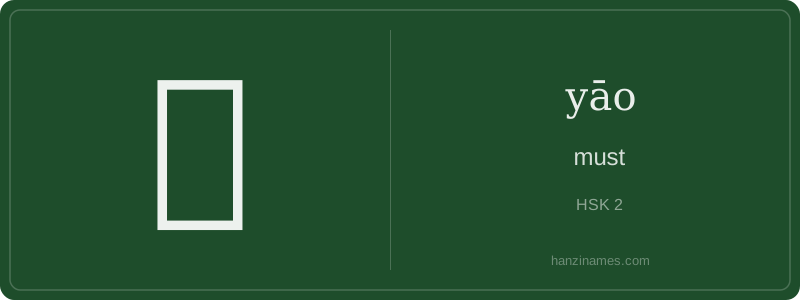
要 is ubiquitous in modern Chinese life: from HSK textbooks (HSK Level 2) to government notices, food delivery apps ('您要加辣吗?'), and WeChat messages ('明天要开会'). A documented high-frequency compound is 要求 (yāoqiú, 'to demand/request'), used officially in labor law and education policy. The idiom 本末倒置,舍本逐末 (běnmò dàozhì, shě běn zhú mò) critiques misplaced priorities—but 要 appears in related phrases like 要紧 (yàojǐn, 'crucial'), historically attested in Ming-dynasty vernacular fiction.
The character’s form derives from ancient script where 覀 (a variant of 西, 'west') top + 女 ('woman') bottom suggested 'to hold fast' or 'to grasp firmly'—not a pictograph, but a semantic-phonetic compound. Archaeological evidence (Shuowen Jiezi, 100 CE) confirms its early use for 'essential' and 'to require', aligning with its enduring grammatical role.
The Chinese character 要 (yāo/yào) is a linguistic chameleon—its pronunciation and meaning shift dramatically with context. When pronounced yāo, it carries forceful, imperative connotations: 'to demand', 'to coerce', or 'to require'—often implying authority, urgency, or even compulsion. This usage appears in formal decrees, legal language, or strong requests, where the speaker asserts control over an outcome.
In contrast, yào is far more common in daily speech, functioning as a modal verb meaning 'want to', 'will', or 'shall'. It expresses intention, necessity, or future action—e.g., 我要去 (wǒ yào qù, 'I will go'). This duality reflects a core feature of Mandarin: tone and context govern semantics more than spelling, unlike English’s fixed orthography.
Culturally, 要 (yāo) resonates with Western concepts like 'command' (as in military orders) or 'stipulation' (in contracts), but lacks the overt aggression of English 'coerce'—it’s often neutral or bureaucratic. Compare it to Latin *volo* ('I want') versus *iubeo* ('I command'): yào leans volitional; yāo leans directive. Neither carries moral judgment by default—its tone depends entirely on syntax, register, and speaker intent.
Example Sentences
Common Compounds
Similar Characters — Don't Mix These Up
Your First Step into Chinese Culture: Get a Chinese Name
Every journey into Chinese begins with a name. Use our free Chinese name generator to create a meaningful, personalized Chinese name that fits you perfectly.
Get My Chinese Name →