丛
Character Story & Explanation
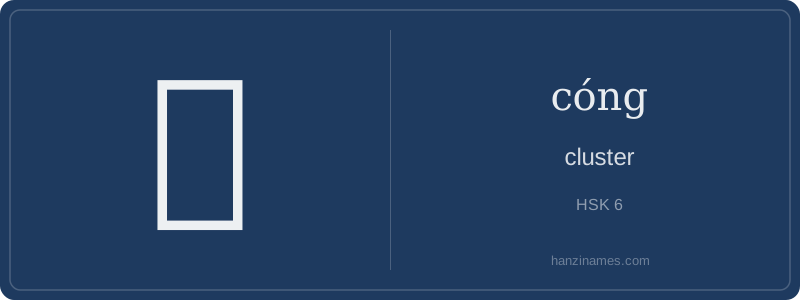
In modern Mandarin, 丛 appears most frequently in compound nouns denoting natural or abstract groupings: 丛林 (cónglín, 'jungle'), 草丛 (cǎocóng, 'thicket'), and 丛书 (cóngshū, 'book series'). It’s also central in the idiom 丛生 (cóngshēng, 'to spring up profusely'), used in media to describe rapidly emerging problems or trends—e.g., 'corruption issues丛生'. Historically, 丛 entered classical texts by the Tang dynasty, appearing in poetry describing wild vegetation and later in bibliographic terminology for multi-volume works.
The character’s earliest attested form appears in Han dynasty clerical script (lìshū), where it shows two simplified tree-like elements above a base. It is *not* an oracle bone or bronze inscription character—it postdates those systems. Its documented origin is functional: a shorthand for 从木 (cóng mù, 'trees following/abounding'), later condensed into a single logograph representing dense, unordered growth.
Our detective begins at the crime scene: the character 丛, five strokes, deceptively simple. At first glance, it looks like two 'trees' (木) stacked—but no. Its radical is 一 (yī), the horizontal line, signaling its classification in dictionaries—not botanical origin. The top is actually 从 (cóng), meaning 'to follow', here simplified and stylized. Historical scripts show early forms with doubled 'tree' elements, hinting at abundance or grouping—yet modern standardization stripped away pictorial redundancy. This isn’t a literal forest; it’s an abstracted glyph born from clerical script refinement.
Zooming in on the stroke order—horizontal, vertical, dot, vertical, dot—we see rhythm, not randomness. Each stroke anchors the next: the first 一 grounds the structure; the second 丨 establishes symmetry; the two dots (丶) act as visual 'seeds' sprouting multiplicity. This economy of form mirrors its semantic core: minimal strokes yielding maximal implication of clustering. No extra lines are tolerated—every element serves density, cohesion, or balance. It’s calligraphy as conceptual compression.
Why does 丛 mean 'cluster' when its components don’t literally depict one? Because Chinese characters often encode meaning through *association*, not illustration. 从 (cóng) implies convergence—people following together—so doubling its simplified upper part evokes collective presence. Over centuries, scribes favored speed and consistency, collapsing variants into this streamlined shape. Thus, 丛 emerged not as a picture of bushes, but as a grammatical shorthand for aggregated, unstructured groupings—plants, ideas, people—where individual units blur into a unified mass. Its power lies in suggestion, not depiction.
Example Sentences
Common Compounds
Similar Characters — Don't Mix These Up
Your First Step into Chinese Culture: Get a Chinese Name
Every journey into Chinese begins with a name. Use our free Chinese name generator to create a meaningful, personalized Chinese name that fits you perfectly.
Get My Chinese Name →