吁
Character Story & Explanation
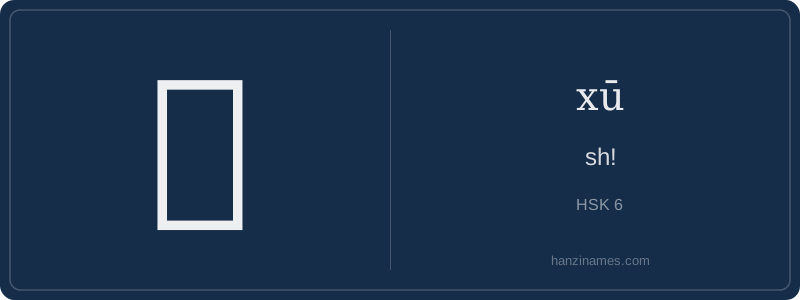
In modern China, 吁 (xū) is most commonly seen in written warnings — like signs outside exam halls, hospital wards, or traditional teahouses — reading '请勿喧哗,吁!' (Please keep quiet — sh!). Though rarely spoken aloud today, it appears frequently in public signage and formal writing to evoke respectful silence. The compound 吁请 (yùqǐng), meaning 'to urgently appeal', is standard in official documents, NGO reports, and news headlines — e.g., '环保组织吁请加强湿地保护' (Environmental groups urgently appeal for stronger wetland protection).
The character combines 口 (mouth) and 于 (a phonetic component, also meaning 'at/in'). Unlike ancient pictographs, 吁 has no verified oracle-bone form; its earliest attestation is in bronze inscriptions and the Warring States bamboo texts, consistently used for vocal expressions — sighs, calls, or hushes — confirming its core link to controlled vocalization.
The character 吁 (xū) is a deceptively simple yet culturally nuanced word. Though it looks like a mouth (口) calling out, its primary modern use is as an interjection — the soft, urgent 'sh!' to hush someone, especially in quiet spaces like libraries, hospitals, or temples. It’s not shouted; it’s whispered with intent, carrying social weight: a polite but firm request for silence rooted in collective awareness.
Historically, 吁 appears in classical texts like the *Book of Songs* (Shījīng), where it functions as a sigh or exclamation of distress — 'Alas!' or 'Oh!'. This older meaning (yù) survives mainly in literary or rhetorical contexts, such as political petitions or solemn appeals: '吁请政府关注…' ('We urgently appeal to the government…'). Its dual pronunciation reflects this semantic split: xū for onomatopoeic hushing, yù for earnest entreaty.
As an HSK Level 6 character, 吁 is rare in casual speech but vital for reading formal Chinese. Learners often confuse it with similar mouth-radical characters, but its minimal stroke count (6) and distinctive right-side component (于) make it visually distinct once mastered. Its power lies in restraint — a single syllable that commands quiet or conveys deep concern, embodying how Chinese uses brevity to carry layered social meaning.
Example Sentences
Common Compounds
Similar Characters — Don't Mix These Up
Your First Step into Chinese Culture: Get a Chinese Name
Every journey into Chinese begins with a name. Use our free Chinese name generator to create a meaningful, personalized Chinese name that fits you perfectly.
Get My Chinese Name →