吟
Character Story & Explanation
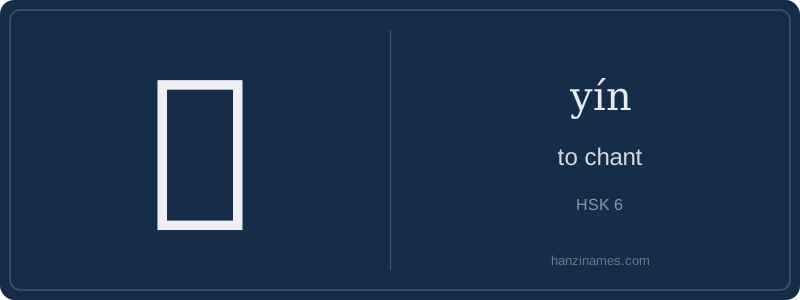
Historically, 吟 was central to literati culture: scholars and poets like Li Bai and Du Fu were said to ‘吟诗’ (yín shī)—chanting poems aloud to refine meter, mood, and resonance. Today, it appears in idioms like ‘低吟浅唱’ (dī yín qiǎn chàng, 'soft chanting and gentle singing'), describing tender, reflective vocal expression. You’ll hear it in classical music performances, poetry recitals, and Confucian temple ceremonies—not in texting or casual speech.
The character’s form is not pictographic but phono-semantic: 口 (kǒu, mouth) signals meaning (speech), and 今 (jīn, 'now') serves as the phonetic component (though pronunciation diverged over time). No oracle-bone origin is confirmed; its earliest attestation is in Warring States bamboo texts, consistently used for melodic recitation.
Hi students! Let’s explore 吟 (yín), a beautiful character meaning 'to chant' or 'to recite'—especially with feeling, rhythm, and poetic expression. Unlike plain reading (读 dú), 吟 suggests a musical, meditative, or emotionally resonant vocalization, often used for classical poetry. It appears in literary contexts, calligraphy, and traditional arts—not daily small talk, but deeply cherished in Chinese cultural memory.
This character belongs to HSK Level 6, so it’s advanced—but don’t be intimidated! Its simplicity (just 7 strokes) belies its elegance. The 口 (mouth) radical tells us it’s speech-related, while the right side (今 jīn, 'now') hints at immediacy and presence—chanting is an act done *here and now*, with full attention. Think of it as ‘voicing poetry from the heart’.
Notice how 吟 differs from similar verbs like 唱 (chàng, 'to sing') or 诵 (sòng, 'to recite formally'). 吟 is quieter, more introspective—like humming a Tang poem under your breath while walking through a garden. It’s not performance; it’s communion. Mastering 吟 helps you appreciate China’s lyrical tradition—and even improves your tone and rhythm when speaking Mandarin!
Example Sentences
Common Compounds
Similar Characters — Don't Mix These Up
Your First Step into Chinese Culture: Get a Chinese Name
Every journey into Chinese begins with a name. Use our free Chinese name generator to create a meaningful, personalized Chinese name that fits you perfectly.
Get My Chinese Name →