呈
Character Story & Explanation
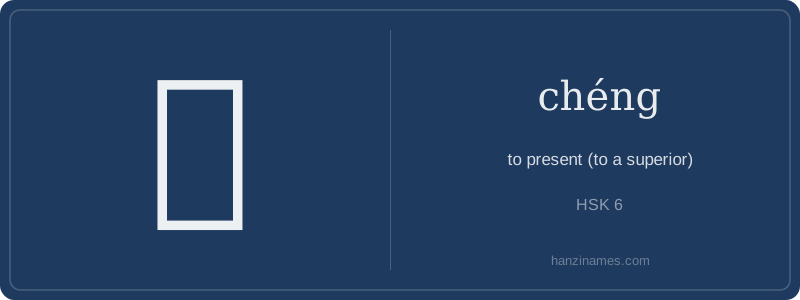
呈 is standard in formal administrative and academic Chinese: government offices require '呈报 (chéngbào)’ for official reports; universities use ‘呈交论文 (chéngjiāo lùnwén)’ for thesis submission. A well-documented phrase is ‘呈请批示 (chéngqǐng pīshì)’—‘respectfully request instructions’, found in countless Ming and Qing dynasty archival documents and still used in modern Party and government memos. The character appears in classical texts like the *Book of Rites*, reinforcing its long-standing role in ritualized address.
The seal script form of 呈 shows 口 (mouth) above 王 (king), confirming its early association with spoken or written address to rulers. Unlike speculative oracle-bone origins, this structure is verified in bronze inscriptions from the Warring States period (475–221 BCE), where 呈 consistently denotes submission of reports or tribute by vassals to sovereigns.
呈 (chéng) is far more than a verb meaning 'to present'—it encodes China’s enduring cultural grammar of hierarchy, respect, and ritualized communication. Its very structure—a 'mouth' radical (口) atop 'king' (王)—suggests speech offered upward, not as casual sharing but as formal, reverent transmission. This reflects the Confucian ideal where language is not neutral but ethically weighted: how one speaks—and to whom—reveals moral posture and social awareness.
In imperial China, 呈 was the linguistic keystone of bureaucratic life: memorials (奏呈 zòu chéng), petitions (呈文 chéng wén), and reports were never mere documents but performative acts of deference. Even today, its usage preserves this gravity—appearing in official correspondence, academic submissions, and ceremonial contexts where humility before authority remains linguistically embedded, not merely rhetorical.
The character thus serves as a quiet cultural compass: it reminds speakers that communication is relational, not transactional. To 呈 is to acknowledge asymmetry—not as inequality, but as ordered harmony. In a society that values guānxi (relationships) and face (miànzi), 呈 carries the weight of trust, propriety, and the unspoken contract between giver and receiver. It’s language as etiquette, ink as intention.
Example Sentences
Common Compounds
Similar Characters — Don't Mix These Up
Your First Step into Chinese Culture: Get a Chinese Name
Every journey into Chinese begins with a name. Use our free Chinese name generator to create a meaningful, personalized Chinese name that fits you perfectly.
Get My Chinese Name →