就
Character Story & Explanation
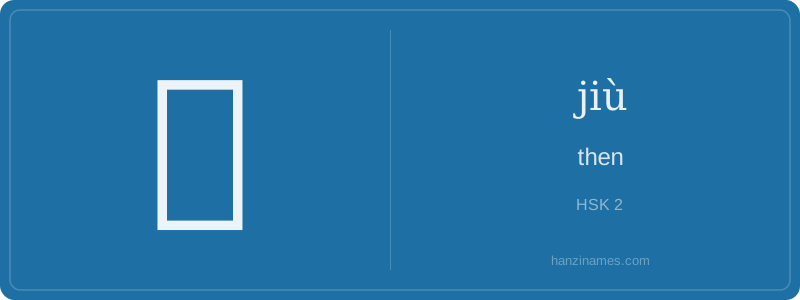
就 is among the top 50 most frequently used characters in modern Mandarin, appearing constantly in spoken and written Chinese — especially in daily conversations, instructions, and media subtitles. It appears in foundational idioms like 就事论事 (jiù shì lùn shì, 'discuss issues on their merits') and the common phrase 马上就来 (mǎshàng jiù lái, 'I’ll be right there'). Linguistic corpora (e.g., Beijing Language and Culture University’s CCL Corpus) confirm its dominance in conversational syntax, particularly in 'if–then' structures and immediacy markers.
Historically, 就 first appeared in seal script (c. 3rd century BCE) with its current radical 尢 (wāng, 'lame' or 'limping') and phonetic component 尤 (also pronounced yóu). The original meaning was 'to approach' or 'to go toward', evolving semantically to 'to settle into' → 'to immediately follow' → 'therefore/then'. Its modern grammatical function solidified during the Ming–Qing vernacular literature period, notably in novels like Water Margin and Dream of the Red Chamber.
The Chinese character 就 (jiù) is a high-frequency grammatical particle with nuanced logical and temporal functions. Unlike English words that express consequence or immediacy (e.g., 'then', 'just', 'already'), 就 operates contextually — it often signals inevitability, emphasis, or a natural progression from condition to result. Its meaning shifts subtly depending on sentence position: before a verb it may indicate immediacy ('as soon as'), before an adjective it adds emphasis ('exactly so'), and in conditional constructions it conveys 'in that case' or 'then'. It rarely stands alone and almost never carries lexical meaning like a noun or verb.
Western equivalents like 'then', 'just', or 'already' are useful starting points but fall short of capturing 就’s pragmatic flexibility. In English, 'then' primarily marks sequence; in Chinese, 就 can imply both temporal proximity *and* logical necessity — e.g., 'If you’re ready, we’ll leave' → '你准备好了,我们就走' (Nǐ zhǔnbèi hǎo le, wǒmen jiù zǒu), where 就 signals not just timing but readiness-triggered action. This dual role reflects a broader East Asian linguistic tendency to embed logic in relational grammar rather than discrete conjunctions.
Culturally, 就 reflects a pragmatic, context-sensitive worldview: meaning arises from situational alignment, not rigid syntax. Compare the English 'Well then...' (often implying resignation or concession) with Chinese 就这样吧 (jiù zhèyàng ba — 'Let it be like this then'), which conveys gentle acceptance rooted in harmony over argument. While Western logic often prioritizes propositional truth, 就 leans into relational coherence — making it less a 'word' and more a grammatical hinge for social and logical flow.
Example Sentences
Common Compounds
Similar Characters — Don't Mix These Up
Your First Step into Chinese Culture: Get a Chinese Name
Every journey into Chinese begins with a name. Use our free Chinese name generator to create a meaningful, personalized Chinese name that fits you perfectly.
Get My Chinese Name →