哼
Character Story & Explanation
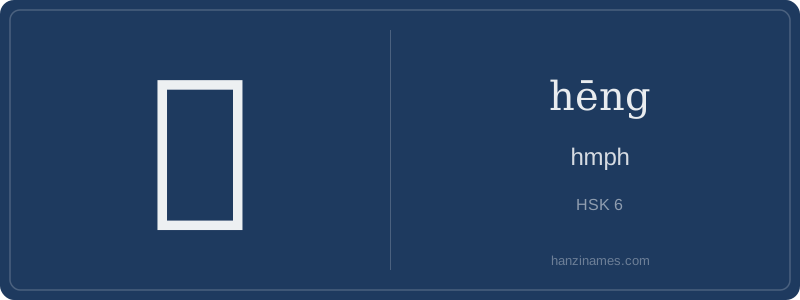
哼 is widely used in modern spoken Mandarin as an expressive interjection—especially in informal dialogue, dramas, and online chats—to signal skepticism ('Hēng? You expect me to believe that?'), dismissiveness ('Hēng, whatever.'), or self-soothing frustration ('Hēng… fine, I’ll do it myself.'). It appears in the common phrase 哼了一声 (hēng le yī shēng, 'gave a hmph') in novels and subtitles, documented in contemporary corpora like the Sinica Corpus and BCC Corpus as a top-20 interjection for pragmatic stance-marking.
The character is not pictographic; its earliest attestation is in seal script (c. 3rd century BCE), showing 口 (mouth) + 亠+厶+巾—likely phonetic components with no literal visual origin. Rather than ancient imagery, its power lies in real-time usage: a teenager rolling their eyes while uttering hēng during a family dispute, or a netizen typing ‘哼!’ after reading a biased news headline—capturing emotional nuance with one character and zero syntax.
‘Hmm’ in English barely scratches the surface of 哼 (hēng)—a character that embodies the Chinese worldview where sound is not just noise, but a vessel for unspoken emotion. In Confucian-influenced communication, direct confrontation is often softened; instead, a low, nasal ‘hēng’ conveys skepticism, disdain, or weary resignation without breaking decorum. It’s a linguistic sigh—polite yet potent, quiet yet unmistakable.
This character reveals how Chinese culture values emotional economy: meaning resides not only in words spoken, but in the vocal textures between them. The mouth radical (口) anchors it in embodied expression—breath, tone, and attitude all converge here. Unlike Western interjections often dismissed as filler, 哼 carries pragmatic weight: it can halt a conversation, signal disagreement without argument, or even serve as passive resistance in hierarchical settings.
Historically, 哼 appears in Ming-Qing vernacular fiction and opera scripts as stage-directional notation for nonverbal vocalization—proving its long-standing role in conveying subtext. Its minimal articulation (no vowel required in colloquial hng) reflects a broader aesthetic principle: *yì jìng* (artistic implication), where what’s withheld speaks louder than what’s declared. To master 哼 is to understand that in Chinese, silence has timbre—and timbre has grammar.
Example Sentences
Common Compounds
Similar Characters — Don't Mix These Up
Your First Step into Chinese Culture: Get a Chinese Name
Every journey into Chinese begins with a name. Use our free Chinese name generator to create a meaningful, personalized Chinese name that fits you perfectly.
Get My Chinese Name →