哑
Character Story & Explanation
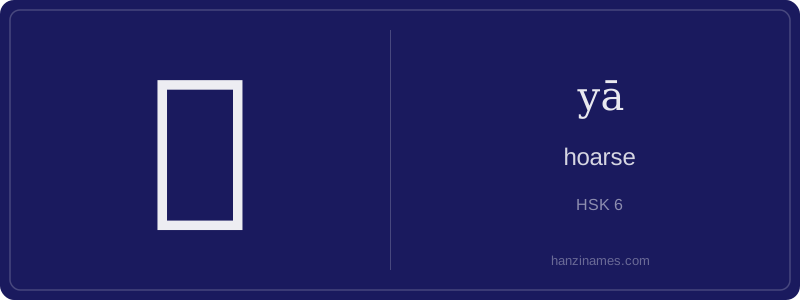
Historically, 哑 appears in Tang and Song dynasty poetry to render onomatopoeic crow calls (e.g., ‘哑哑’ yāyā), and in medical texts like the Compendium of Materia Medica (Bencao Gangmu, 1596) to describe voice loss due to throat disorders. Today, it’s most commonly used in compounds like 哑巴 (yǎba, ‘mute person’) and 哑剧 (yǎjù, ‘mime’), and appears in idioms such as 振聋发聩 (zhènlóng fākuì)—where ‘发聩’ implies rousing the deaf, contrasting with 哑’s silence. It’s also frequent in modern expressions like 哑火 (yǎhuǒ, ‘misfire’), borrowed metaphorically from firearms to mean ‘a plan that fails silently’.
The character is a phono-semantic compound: 口 (kǒu, ‘mouth’) is the semantic radical, indicating relation to speech or sound; the phonetic component is 亚 (yà), which approximates the pronunciation. No oracle-bone or bronze script form survives—it first appears clearly in clerical script (Lishu) during the Han dynasty, consistent with many late-developing characters for nuanced vocal states.
The character 哑 (yā/yǎ) opens a subtle window into the Chinese worldview: sound is not merely acoustic—it’s relational, contextual, and morally weighted. Its radical 口 (mouth) anchors it in human expression, yet its meaning diverges from speech itself—pointing instead to *absence* (muteness) or *non-human vocalization* (cawing). This duality reflects a classical sensibility where silence carries weight equal to speech, and animal sounds are not background noise but meaningful signs in nature’s rhythm.
In classical Chinese poetics, the ‘caw’ of crows (often written as 哑哑) evokes autumnal stillness or melancholy—think of Du Fu’s lines where crow calls underscore solitude. The character thus embodies a worldview where voice is never neutral: it can signify loss of speech (as in trauma or censorship), natural harmony, or even poetic restraint. Silence isn’t emptiness; it’s a vessel charged with implication.
Modern usage deepens this cultural layer: 哑巴 (yǎba, ‘mute person’) appears in literature and film not just descriptively, but ethically—highlighting social invisibility or unvoiced suffering. Even in tech, ‘哑设备’ (yǎ shèbèi, ‘dumb device’) borrows the idea of non-responsive, non-speaking hardware. Thus, 哑 teaches that in Chinese thought, the capacity—or incapacity—to speak shapes identity, power, and belonging far beyond phonetics.
Example Sentences
Common Compounds
Similar Characters — Don't Mix These Up
Your First Step into Chinese Culture: Get a Chinese Name
Every journey into Chinese begins with a name. Use our free Chinese name generator to create a meaningful, personalized Chinese name that fits you perfectly.
Get My Chinese Name →