喉
Character Story & Explanation
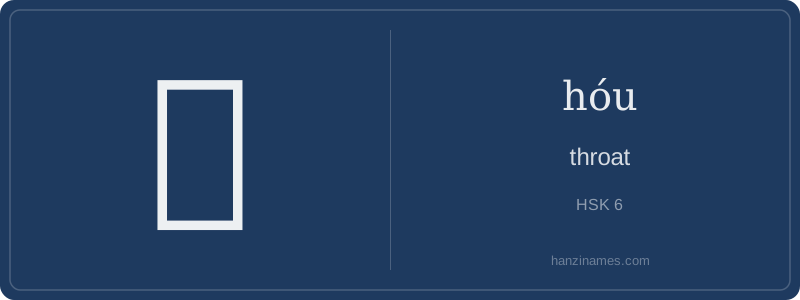
喉 is commonly used in modern medical contexts (e.g., 喉炎 hóuyán, 'pharyngitis'), TCM diagnoses, and formal expressions like 喉舌 (hóushé, 'spokesperson'). It appears in the classical idiom '病从口入,祸从口出' (illness enters through the mouth, disaster emerges from the mouth)—where 喉 implicitly anchors the oral passage. Historical texts such as the Song-dynasty Taiping Yulan cite 喉 in anatomical descriptions aligned with acupuncture theory.
The character is not pictographic in origin; its earliest attested form appears in seal script (c. 3rd century BCE), showing 口 (mouth) + 侯 (hóu, originally 'nobleman'—here serving phonetically). The '侯' component contributes pronunciation, not meaning—a common phono-semantic compound structure confirmed by Shuōwén Jiězì (100 CE).
The character 喉 (hóu) embodies the Chinese worldview that the body is a microcosm of nature and social harmony—where breath, voice, and nourishment converge. Its radical 口 (mouth) signals not just anatomy but communication: the throat is where intention becomes sound, where silence breaks into speech or song. In traditional Chinese medicine (TCM), 喉 is a vital gateway—linked to the Lung and Kidney meridians—reflecting the belief that health flows through interconnected channels, not isolated organs.
Unlike Western dualism separating mind and body, 喉 bridges inner vitality and outer expression. A hoarse voice isn’t merely vocal strain—it may indicate 'lung qi deficiency' or emotional stagnation, revealing how language, physiology, and ethics intertwine. This holistic lens treats the throat as both physical passage and moral conduit: speaking truthfully ('clearing the throat' of falsehood) aligns with Confucian ideals of sincerity and righteous speech.
In classical texts like the Huangdi Neijing, 喉 appears alongside terms like 氣 (qì) and 脈 (pulse), reinforcing its role in life-force circulation. Even today, idioms like 喉舌 (hóushé, 'throat and tongue') metaphorically denote spokespersons—underscoring that authority resides not only in power but in the embodied act of articulation. Thus, 喉 is never just tissue; it’s where culture breathes, speaks, and sustains itself.
Example Sentences
Common Compounds
Similar Characters — Don't Mix These Up
Your First Step into Chinese Culture: Get a Chinese Name
Every journey into Chinese begins with a name. Use our free Chinese name generator to create a meaningful, personalized Chinese name that fits you perfectly.
Get My Chinese Name →